The Rooster, King of the Backyard 🇬🇧
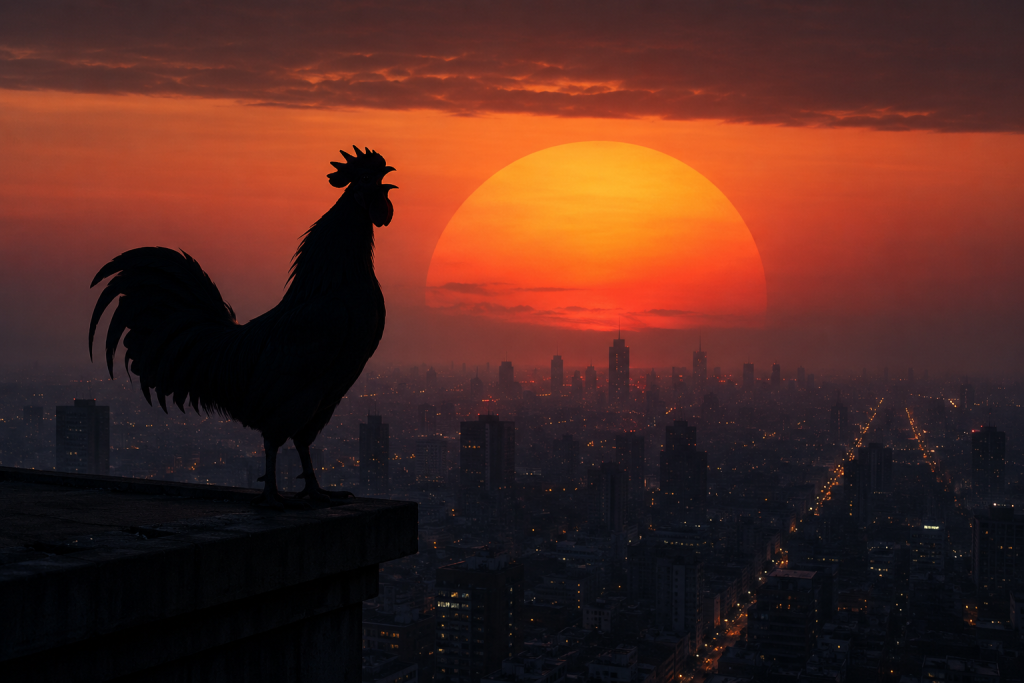
The rooster is not particularly remarkable in terms of size, but its behaviour is nonetheless very interesting and playful. Some of us may wonder whether it is biblical to observe nature or the rooster? Yet it is often through nature that the Lord imparts His teachings to us, so that through visible things we may understand invisible (spiritual) things. Examples of Elohim’s (God’s) teachings in nature: Mishlei/Proverbs 6:6–8: YHWH commands the sluggard to go and observe the ant so that he may become wise. 1 Corinthians 11:14: Paul tells us that nature teaches us Qoheleth/Ecclesiastes 3:1: “To everything there is a season”. Having received wisdom and observed nature, Shelomoh (Solomon) tells us that there is a time for everything. This is something we forget when we face difficulties or fail to obtain what we desire! Having clarified this, we can now delve into the observation and (non-exhaustive) study of the rooster. We shall therefore discuss what we see and observe and then attempt to interpret it. I) Biological profile The rooster (Gallus gallus domesticus), also known as the “farmyard rooster”, is a male domestic animal that was introduced to Europe from Asia Minor. It has colourful feathers and a red comb on top of its head. It also has a spur on its leg, which distinguishes it from the hen, its female counterpart. The rooster hatches from an egg and is initially a yellow chick. As it grows, it becomes a young rooster and subsequently an adult rooster. Its diet consists mainly of insects, grains, grass, earthworms and, surprisingly, pebbles and sand. The rooster has a beak without teeth but is equipped with a highly muscular stomach (the gizzard). It therefore uses the pebbles to grind up the grains as its stomach contracts. When the rooster finds food, it alerts its companions so that they may come and eat. Before evening or nightfall, the rooster returns to the henhouse or to his usual sleeping spot, thereby signalling to the others, who follow him, to prepare for sleep. The rooster is a feisty animal who is not intimidated by the size of his opponent. He does not hesitate to charge to defend his territory or his flock. A rooster can mate up to 30 times a day, and a male can fertilise 6 to 10 hens. The sperm deposited can be stored inside the hen, enabling it to fertilise subsequent eggs for up to four weeks. But what really sets him apart is his crow – inimitable and incomparable, this call rings out whatever the season or circumstances, particularly at dawn whilst it is still dark, thereby heralding the sun’s impending victory and the certain arrival of light. II) Analysis and interpretation according to the Word 1) Unmistakable? By its plumage, appearance and behaviour, a fully-grown rooster could never be mistaken for a hen. Unfortunately, these days it is very often difficult to tell the difference between those who call themselves Christians and the people of the world. Indeed, they dress (indecently), speak (using insults, coarse language and frivolity), act and behave in the same way, using the excuse that no one is perfect and that ELOHIM looks at the heart and not at outward appearance. Romans 12:2 “And do not be conformed to this age: but be transformed by the renewing of your mind, for you to examine what is Elohim’s good, and well pleasing, and perfect will”. 2) Feeding and growing The fact that the rooster has no teeth would normally mean it is destined to eat only light or soft foods (porridge, purée). Yet it manages to eat solid food (seeds) thanks to its muscular stomach and the pebbles it swallows. Applied to Christians: Hebrews 5:12 “For though by this time you ought to be teachers, you have need someone to teach you again the first principles of the oracles of Elohim, and you have become those having need of milk, and not of solid food”. A Christian who is still at the stage of milk because they lack the ability to understand, analyse or delve deeper into the Word should not remain in that state, but must seek the assistance of mature believers in the Word (pebbles, sand) to help them assimilate the Word and subsequently grow themselves. 3) Passing on nourishment rather than keeping it to oneself The rooster alerts the rest of the farmyard when he finds food. It must be said that many Christians do not share the things necessary for salvation and spiritual growth, for fear that others will surpass them, or for fear of no longer being indispensable. Mishlei/Proverbs 11:26 “He that withholds corn, the people will curse him (…)”. Acts 20:20 “How I drew back nothing that was profitable, not to announce to you, and have taught you publicly, and in the houses”. 2 Melakhim/2 Kings 7:8–9 “8 And when these lepers came to the uttermost part of the camp, they went into one tent, and did eat and drink, and carried thence silver, and gold, and raiment, and went and hid it; and came again, and entered into another tent, and carried thence also, and went and hid it. 9 Then they said one to another, We do not well: this day is a day of good tidings, and we hold our peace: if we tarry till the morning light, some mischief will come upon us: now therefore come, that we may go and tell the king’s household”. We have received the Gospel freely; we must in turn pass it on freely, so that everyone may benefit from it and we may all be on the same level. 4) Being a living example In the morning, by being the first to leave the henhouse; in the heat of the day, by being the first to seek the shade; and in the evening, by giving the signal to go to bed, the rooster thus regulates life in the henhouse. The Christian, too, is the salt and light of the world.
The Rooster, King of the Backyard 🇬🇧 Weiterlesen »