
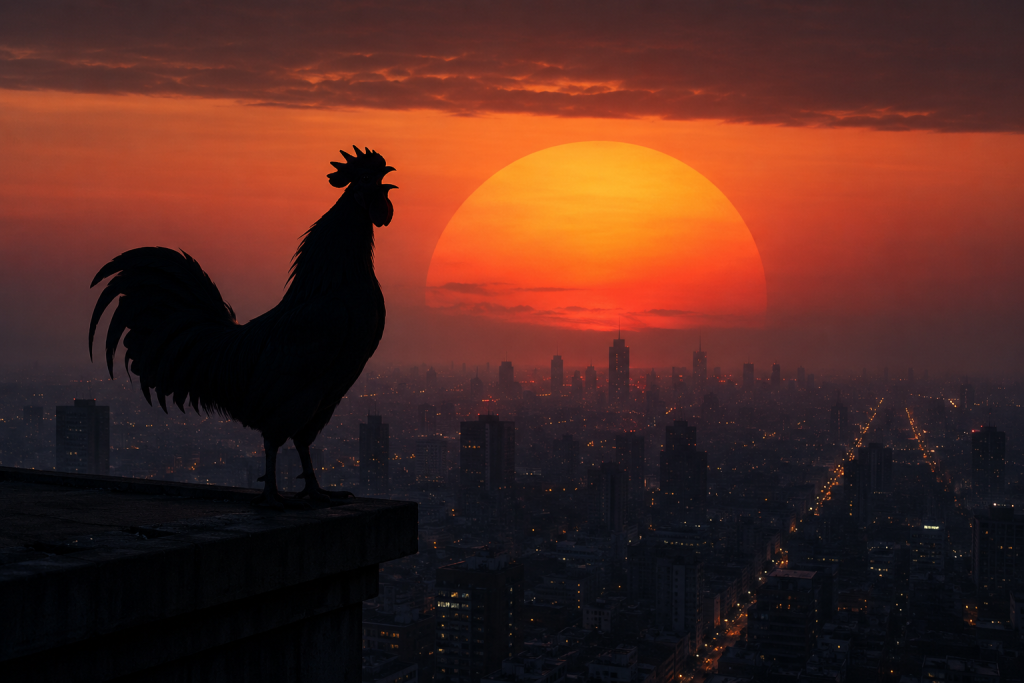
The rooster is not particularly remarkable in terms of size, but its behaviour is nonetheless very interesting and playful. Some of us may wonder whether it is biblical to observe nature or the rooster? Yet it is often through nature that the Lord imparts His teachings to us, so that through visible things we may understand invisible (spiritual) things.
Examples of Elohim’s (God’s) teachings in nature:
- Mishlei/Proverbs 6:6–8: YHWH commands the sluggard to go and observe the ant so that he may become wise.
- 1 Corinthians 11:14: Paul tells us that nature teaches us
- Qoheleth/Ecclesiastes 3:1: “To everything there is a season”. Having received wisdom and observed nature, Shelomoh (Solomon) tells us that there is a time for everything. This is something we forget when we face difficulties or fail to obtain what we desire!
Having clarified this, we can now delve into the observation and (non-exhaustive) study of the rooster. We shall therefore discuss what we see and observe and then attempt to interpret it.
I) Biological profile
The rooster (Gallus gallus domesticus), also known as the “farmyard rooster”, is a male domestic animal that was introduced to Europe from Asia Minor. It has colourful feathers and a red comb on top of its head. It also has a spur on its leg, which distinguishes it from the hen, its female counterpart. The rooster hatches from an egg and is initially a yellow chick. As it grows, it becomes a young rooster and subsequently an adult rooster.
Its diet consists mainly of insects, grains, grass, earthworms and, surprisingly, pebbles and sand. The rooster has a beak without teeth but is equipped with a highly muscular stomach (the gizzard). It therefore uses the pebbles to grind up the grains as its stomach contracts. When the rooster finds food, it alerts its companions so that they may come and eat.
Before evening or nightfall, the rooster returns to the henhouse or to his usual sleeping spot, thereby signalling to the others, who follow him, to prepare for sleep. The rooster is a feisty animal who is not intimidated by the size of his opponent. He does not hesitate to charge to defend his territory or his flock. A rooster can mate up to 30 times a day, and a male can fertilise 6 to 10 hens. The sperm deposited can be stored inside the hen, enabling it to fertilise subsequent eggs for up to four weeks.
But what really sets him apart is his crow – inimitable and incomparable, this call rings out whatever the season or circumstances, particularly at dawn whilst it is still dark, thereby heralding the sun’s impending victory and the certain arrival of light.
II) Analysis and interpretation according to the Word
1) Unmistakable?
By its plumage, appearance and behaviour, a fully-grown rooster could never be mistaken for a hen. Unfortunately, these days it is very often difficult to tell the difference between those who call themselves Christians and the people of the world. Indeed, they dress (indecently), speak (using insults, coarse language and frivolity), act and behave in the same way, using the excuse that no one is perfect and that ELOHIM looks at the heart and not at outward appearance.
Romans 12:2 “And do not be conformed to this age: but be transformed by the renewing of your mind, for you to examine what is Elohim’s good, and well pleasing, and perfect will”.
2) Feeding and growing
The fact that the rooster has no teeth would normally mean it is destined to eat only light or soft foods (porridge, purée). Yet it manages to eat solid food (seeds) thanks to its muscular stomach and the pebbles it swallows.
Applied to Christians:
Hebrews 5:12 “For though by this time you ought to be teachers, you have need someone to teach you again the first principles of the oracles of Elohim, and you have become those having need of milk, and not of solid food”.
A Christian who is still at the stage of milk because they lack the ability to understand, analyse or delve deeper into the Word should not remain in that state, but must seek the assistance of mature believers in the Word (pebbles, sand) to help them assimilate the Word and subsequently grow themselves.
3) Passing on nourishment rather than keeping it to oneself
The rooster alerts the rest of the farmyard when he finds food. It must be said that many Christians do not share the things necessary for salvation and spiritual growth, for fear that others will surpass them, or for fear of no longer being indispensable.
Mishlei/Proverbs 11:26 “He that withholds corn, the people will curse him (…)”.
Acts 20:20 “How I drew back nothing that was profitable, not to announce to you, and have taught you publicly, and in the houses”.
2 Melakhim/2 Kings 7:8–9 “8 And when these lepers came to the uttermost part of the camp, they went into one tent, and did eat and drink, and carried thence silver, and gold, and raiment, and went and hid it; and came again, and entered into another tent, and carried thence also, and went and hid it. 9 Then they said one to another, We do not well: this day is a day of good tidings, and we hold our peace: if we tarry till the morning light, some mischief will come upon us: now therefore come, that we may go and tell the king’s household”.
We have received the Gospel freely; we must in turn pass it on freely, so that everyone may benefit from it and we may all be on the same level.
4) Being a living example
In the morning, by being the first to leave the henhouse; in the heat of the day, by being the first to seek the shade; and in the evening, by giving the signal to go to bed, the rooster thus regulates life in the henhouse. The Christian, too, is the salt and light of the world. Through his life, his observance of the Torah and his love for YHWH, he inspires a desire to live in the world. The way he lives as a partner, within his family with his children, and at work gives others a taste for and a desire to live that way, demonstrating that it is possible.
Mattithyah/Matthew 5:13-14 “13 You, you are the salt of the Earth. But if the salt has lost its strength and its savor, how can it be made salty again? It is no longer fit for anything but to be cast out and to be trodden under foot by men. 14 You, you are the light of the world. A city located on a mountain cannot be hidden”.
5) Sowing seeds, producing offspring
The fact that a rooster can sire offspring as much as four weeks later is no trivial matter and is even mentioned in the Bible. Paul indeed says to Timothy:
2 Timothy 2:2 “And the things that you have heard from me through many witnesses, entrust these to faithful humans, who will be sufficient to teach them to others as well”.
What you have received, you must also entrust to capable people, this ability coming, of course, from Elohim:
2 Corinthians 3:5–6 “5 not that we are sufficient of ourselves to think anything as out of ourselves, but our ability is out of Elohim, 6 who also made us sufficient to be servants of the new covenant, not of the letter, but of the Spirit, for the letter kills, but the Spirit gives life”.
The seed received (the gospel, the doctrine) must be passed on to others who will later be able to pass it on again. When speaking of “sufficient” people, Paul is referring to those who will not view the gospel as a source of profit, who will not obscure it to make it inaccessible. There was, for example, a time, not so long ago, when the Word was available only in Latin and reserved for an elite. Although Paul – just like the Master, Yeshua – has left us, his Gospel continues to touch many people.
6) Courage in the face of a powerful enemy
Some may say or think that the rooster is reckless and foolish to attack someone far larger and stronger than himself. This attitude reminds us of that of a man after Elohim’s own heart: the attitude of David after enduring Goliath’s insults and taunts directed at his Elohim. Strengthened by YHWH’s deliverances during his battles against the lion and the bear, David had the firm assurance (faith) that Goliath would fall into his hands. This assurance rested neither on strength nor on powerful weapons; indeed, David rejected the finest armour in all Israel (that of the king) to gather stones smoothed by the stream
1 Shemouél/1 Samuel 17:40 “And he took his staff in his hand, and chose him five smooth stones out of the brook, and put them in a shepherd’s bag which he had, even in a scrip; and his sling was in his hand: and he drew near to the Philistine”.
As water most often symbolises the Word, the Christian will find the strength to overcome his mighty enemies in the Word and not in the things of this world, whilst maintaining faith and remembering the deliverances and blessings of YHWH.
7) The rooster’s crow that has fallen silent
If we were to conduct a survey on what characterises the rooster, it would undeniably be its crow. How can we explain that an animal without a watch can crow on the hour? How does it know that darkness will give way to light? No matter how many times the farmer threatens it, it will never stop crowing. The rooster could be compared to a zealous prophet, driven by a consuming fire that nothing and no one can prevent from announcing the imminent coming of his Elohim, the sun.
It is a great help to those who must get up very early to go to work. However, its crowing, so much appreciated in days gone by, has completely disappeared from towns and urban areas due to noise pollution, and is now heard only in the countryside or in villages.
Where are the Christians? They are certainly there but have fallen silent in the face of threats and the judgemental glances of others. Many have lost the song heralding the coming of the bright morning star, whilst creation eagerly awaits the revelation of the sons of Elohim
Romans 8:19 “For the earnest expectation of the creation awaits assiduously and patiently the revelation of the sons of Elohim.”.
Just as labourers await the rooster’s crow to rouse them from their sleep, the so-called Christian roosters, through their new crows, sadly plunge souls—which are in need of salvation—into an even deeper slumber.
8) The false crowing of the rooster
Yohanan 14:6 “Yehoshua says to him: I am the Way, the Truth and the Life. No man comes to the Father but by me”.
Although Yeshua clearly stated that apart from him there is no other way, some Christians claim that it is the same Elohim who manifests himself in various forms across different religions or denominations, based on the saying “all roads lead to Rome” or under the influence of ecumenism.
The crowing of the rooster is of paramount importance; it may be tempting to assume that every rooster’s crow is both beautiful and useful. When we look at Goliath in the book of 1 Shemouél/1 Samuel, we see that he would come forward in the morning and then in the evening to “crow”:
1 Shemouél/1 Samuel 17:16 “And the Philistine drew near morning and evening, and presented himself forty days”.
His crowing consisted of insulting the Israelites and their Elohim. Instead of rousing Israel’s fighting spirit, this crowing brought fear and discouragement for 40 consecutive days.
III) A true call to wake up
We can see, then, that it is not enough simply to be a rooster and to rise early; the message is important, and the sender above all else. Let us look at the example of the rooster that mandated by the Lord Yehoshua to call out and awaken his disciple Petros, who had just denied him three times in a row:
Mattithyah/Matthew 26:69-75 „69 Now Petros was sitting outside in the courtyard. And a maid came to him, saying: You too were with Yehoshua the Galilean. 70 But he denied it before them all, saying: I do not know what you are talking about. 71 And when he had gone out to the gateway, another saw him and said to those who were there: This one was with Yehoshua the Nazarite. 72 And again he denied with an oath: I do not know the man. 73 And after a while those standing near having come, said to Petros: Truly you also are out of them, for even your speech makes you evident. 74 Then he began to curse and swear: I do not know the man. And immediately the rooster crowed. 75 And Petros remembered the word which Yehoshua had said: Before the rooster crows, you will deny me three times. And having gone outside, he wept bitterly“.
As roosters of Elohim, our crowing must awaken the souls of both pagans and Christians alike; it must encourage souls, not discourage or condemn them; it must proclaim Yeshua’s victory over the darkness that now reigns and his imminent return.
Mattithyah/Matthiew 25:1-7 „1 Then the Kingdom of the heavens will be like ten virgins who, having taken their lamps, went out to meet the bridegroom. […] 5 And the bridegroom delaying, they all slumbered and slept. 6 And in the middle of the night, there was a cry made: Behold, the bridegroom comes, go out to meet him! 7 Then all those virgins woke up and prepared their lamps„.
May YHWH awaken all our souls and grant us the grace to reconsider the rooster, so that we may truly follow his example in these matters.