Articles in English

The spiritual battle (Part III): The fight for the faith 🇬🇧

Bible passages: Daniel 10 and Hebrews 11. 1) The liberating message The angel with the gospel In Daniel 10 we read of the angel who was sent to Daniel. The angel was like a prophet who had a liberating gospel [1] to deliver. This message was not meant to reach Daniel and the people, so that this people might not be set free. Daniel 10:1–6, 9–14: „1 In the third year of Cyrus king of Persia a thing was revealed to Daniye’l, whose name was called Belteshazzar; and the thing was true, but the time appointed was long: and he understood the thing, and had understanding of the vision. 2 In those days I Daniye’l was mourning three full weeks. 3 I ate no pleasant bread, neither came flesh nor wine in my mouth, neither did I anoint myself at all, till three whole weeks were fulfilled. 4 And in the four and twentieth day of the first month, as I was by the side of the great river, which is Hiddekel; 5 Then I lifted up mine eyes, and looked, and behold a certain man clothed in linen, whose loins were girded with fine gold of Uphaz: 6 His body also was like the beryl, and his face as the appearance of lightning, and his eyes as lamps of fire, and his arms and his feet like in color to polished copper, and the voice of his words like the voice of a multitude (…) 9 Yet heard I the voice of his words: and when I heard the voice of his words, then was I in a deep sleep on my face, and my face toward the ground. 10 And behold, a hand touched me, which set me upon my knees and upon the palms of my hands. 11 And he said to me, O Daniye’l, a man greatly beloved, understand the words that I speak to you, and stand upright: for to you am I now sent. And when he had spoken this word to me, I stood trembling. 12 Then said he to me, Fear not, Daniye’l: for from the first day that you did set thine heart to understand, and to chasten yourself before your Elohim, your words were heard, and I am come for your words. 13 But the prince of the kingdom of Persia withstood me one and twenty days: but, behold, Michael, one of the chief princes, came to help me; and I remained there with the kings of Persia. 14 Now I am come to make you understand what will befall your people in the latter days: for yet the vision is for many days (…)“ [2]. The Resistance What the angel had to bring was the current, timely message. The word „angel“ is also „mal’Ach“ in Hebrew, which means „messenger“. The prince of Persia, that is, this spiritual power, did not want to let this highly topical gospel into the kingdom. For there were people imprisoned there who were in danger of gaining their freedom through the message. Since this prince knew this, he offered resistance. Types of Captivity People on earth have been bound since the Fall. They are subject to different kinds of yoke/slavery/captivity: Sin, Tradition, customs People: Example: A woman who is beaten by her husband is under his yoke. Submission in a marriage must be mutual, not one-sided! Demons Religious, ceremonial laws 2) What is the battle of faith? What the battle of faith is not Faith is not asking for a wedding, a Mercedes or a BMW, etc. There are people who are afraid of ghosts at night and pray all night long. They want to drive out evil using a method and have no real faith. Fighting for faith therefore does not mean fighting against demons all day long. The battle of faith has absolutely nothing to do with a physical battle with weapons, as Islam, for example, propagates [3]. Faith: What is it? Faith comes from the Spirit/from the Word John 6:63: „It is the Spirit who gives life, the flesh profits nothing. The words that I speak to you are spirit, and are life„. Faith is spiritual, for it is born of the Word: „14 How then will they call upon whom they have not believed in? And how will they believe in him of whom they have not heard? And how will they hear without preaching? 15 And how will they preach, if they are not sent? As it has been written: How beautiful the feet of those preaching the Gospel of peace, and those bringing the Gospel of good things!“ (Romans 10:14-15). To believe is not to see We are spirits who are meant to speak with Elohim, the Spirit. If you believe in invisible things, it is because of your faith. If you believe in the existence of hell, even though you have never seen it, it is because of your faith. Hebrews 11:1: „Now faith is the foundation of things hoped for, the conviction of things not seen“. Faith is more than simply believing that Elohim grants us things. To believe means to trust Elohim blindly, that is, to close your eyes and carry on. The Christian way does not consist of looking first and then going there. Even if I pray and Elohim does not heal me, I believe; even if I die, I believe that Elohim has already healed me in the Spirit and that I will spend eternity with him. Abraham, for example, believed that Elohim could raise his son Yitzhak (Isaac) from the dead, even though he had never seen or heard of such a thing before. Faith is obedience Faith is obedience to Elohim and doing what Elohim tells you, no matter what is happening around you. Iyov (Job), for example, obeyed Elohim even though many terrible things happened in his life. Living Faith Faith is not dead. It is accompanied by actions. If you only listen to armchair sermons where nothing happens, that is dead faith.

The spiritual battle (Part III): The fight for the faith 🇬🇧 Weiterlesen »

The spiritual battle (Part IV): Satan’s snares 🇬🇧

1 Timothy 3:1–7: „1 The word is sure, if anyone desires the office of overseer, he desires an excellent work. 2 But an overseer must be irreproachable, the husband of one wife, moderate, limiting his desires and his impulses, decent, hospitable, able to teach, 3 not given to wine, not a striker, not greedy for money, but gentle, not aggressive, not loving money, 4 leading properly his own house, having his children in submission, with all dignity. 5 But if one does not know how to lead his own house, how will he take care of the assembly of Elohim? 6 Let him not be a new convert, lest having been puffed up with pride he fall under the judgment of the devil. 7 But he must also have a good testimony from those who are outside lest he fall into disgrace and the snares of the devil.“ [1]. 1) Clarification of terms „krima“ (Greek) = judgment; judgement at the end of time; (punitive) judgement, condemnation; damnation; legal proceedings. „pagis“ (Greek) = trap, snare, noose, temptation. 2) To exercise judgement Satan himself is subject to Elohim’s judgement at the end of time. But he also has the power to exercise judgement and destroy in the present. He constantly passes judgement on people who sin. Once you have fallen into Satan’s trap, he will judge you according to your deeds. That is why he tries to ensnare us with the things we enjoy. For he knows exactly what we like and what we do not. Satan’s intentions 2 Timothy 2:24–26: „24 Now it is not right and proper that a slave of the Lord should have quarrels, but that he should be gentle to all, able to teach, patient to faults, 25 correcting with gentleness those who feel otherwise: Perhaps Elohim will give them repentance for the precise and correct knowledge of the truth, 26 and that they may return to sobriety out of the devil’s snare, having been captured by him for his will„ Satan always tries to lead us away from sanctification, the fear of Elohim, from the discipline of prayer and the Word of Elohim, and thus from the faith. Furthermore, he wishes to kill those who pose a great threat to him. For instance, he knows that a person might win over 1 million people for Yehoshua (Jesus), and that each of these people will in turn win over other souls. This was the case with Moshe (Moses), who as a baby was exposed to the danger posed by Pharaoh, and with Yehoshua, who was persecuted by King Herod. 3) The Snares A snare explained using the example of a fishing rod The following image illustrates how Satan catches people. With the help of the fishing line, the fish is pulled in one direction as soon as it has taken the bait. The person caught in this way does Satan’s will.   The Desires Just as Elohim has books in which the deeds of the saved are recorded, so too does Satan have books in which everything concerning each individual is recorded: their daily routine, their preferences… He knows our desires well, for they are also his own desires: „You are out of your father the devil, and you want to do the desires of your father„ (John 8:44). The Greek word for „desire“ means: personal longing, passion of the sick soul [2]. 2 Timothy 2:22: „But flee the desires of youth and run after righteousness, faith, love, peace, with them calling upon the Lord out of a pure heart“. Mark 4:19: „and the cares of this age, and the deceitfulness of riches and the lusts of other things entering in, choke the word, and it becomes unfruitful“.   The fruit of the tree of the knowledge of good and evil The fruit by which Chavvah (Eve) was tempted by the devil was beautiful to look at and appeared very tasty. What Eve did not know was that all the troubles of the world and of all humanity were hidden within it. She need only have been obedient, but her desire was stronger. The fruit served as bait. Just as this fruit contained all the curses for Eve, so too do Satan’s traps for you contain all the curses at once. Thus, with a single misstep, you can bring many sins into your life at once, along with sickness and other misfortunes.   Satan’s baits To catch you, Satan has his servants everywhere: in schools, hospitals, offices, churches… He knows who belongs to him and brings these people (whether they are aware of it or not) to the place where he needs them to influence others. There are people who will never be saved, no matter how many biblical teachings they receive. They have hardened hearts and are there to ensnare others—those who are wavering—by first observing them. For the devil studies his prey closely. He knows that we are highly emotional beings and exploits this. If one’s spiritual eyes were open, one would see the fishing line by which many people are led. Effective bait: a spouse Let us imagine that someone is meant to serve Elohim. From birth, they have had certain gifts and a calling. The devil knows or senses this too, as a certain anointing surrounds this person. He will try, for example, to bring this person together with a wife or husband who has nothing to do with Elohim but is full of demons, and who is intended to lead the servant away from Elohim’s purpose. If the two become a couple, the servant originally intended for Elohim takes on the demons and also inherits the curses of his in-laws. He is blocked. Some people have lost many years because they married the wrong person.   Example: King Ahab and his wife Jezebel The Israelite King Ahab took a fancy to a Sidonian princess who was also a priestess of Baal. She brought down both her husband and the entire nation that stood

The spiritual battle (Part IV): Satan’s snares 🇬🇧 Weiterlesen »

The testimony of Yehoshua Mashiah (Jesus Christ) 🇬🇧

1 John 5:6-8: „6 It is this Yehoshua ha Mashiah who came through water and blood; not with water alone, but with water and blood. And it is the Spirit that bears witness, because the Spirit is truth. 7 For there are three that bear witness in heaven: the Father, the Word, and the Holy Spirit, and these three are one. 8 And there are three who bear witness in the Earth: the Spirit, and the water, and the blood, and these three are for one“. If one reads the highlighted section of this Bible passage, one might assume that it refers to three persons who ‚reign‘ in heaven to bear witness to Yehoshua Mashiah (Jesus Christ). We wish to refute this. 1) What is a witness? According to the dictionary (Google), a witness is 1. a „person who has observed a particular incident“ and 2. a „person who testifies in court“. 2) The witnesses to the Sonship of God:  Background – the Old Covenant The Apostle Yohanan (John) explains, both in his Gospel and in 1 John, which witnesses testify for Yehoshua Mashiah because they know him. We must not forget, particularly regarding Yehoshua’s own statements, that he was speaking to Jews at that time and had not yet died, meaning the Old Covenant was still in force. This stipulated that a single witness had no validity.    Witnesses who are not sufficient Yehoshua asserts in John 5:31: „If I bear witness concerning myself, my testimony is not true“.  He speaks these words against the backdrop of the Mosaic Law:  „… at the mouth of two witnesses, or at the mouth of three witnesses, will the matter be established„ (Deuteronomy 19:15; John 8:17).  Furthermore, Yehoshua is speaking here of himself as a human being, not as Elohim (God). John 5:33–34: „33 You have sent to Yohanan, and he has borne witness to the truth. 34 But I do not receive witness from human being …“.  As Elohim, Yehoshua cannot accept the testimony of a human being, because it is not sufficient. He needs divine testimony! Valid witnesses: Bible passages Yehoshua, as Elohim, bears witness to himself, because he knows where he came from and where he is going (John 8:14).  „[…] He who is coming out of heaven is above all, 32 and what he has seen and heard, that he testifies, but no one receives his testimony. 33 He having received his testimony has set a seal that Elohim is true“ (John 3:31–33).  We know that Elohim is in heaven and that only Elohim can come from heaven, nothing human. The Father who sent him bears witness to him (John 8:18; John 5:37). He is both the one who sent him and the one who has come. The works of Yehoshua/Elohim bear witness to him (John 5:36; John 10:25). The Scriptures bear witness to Yehoshua (John 5:39). The Scriptures are the Word of Elohim (more on this in the following chapter). Yehoshua’s disciples bear witness to him (Acts 1:8). 3) The witnesses in heaven „For there are three that bear witness in heaven: the Father, the Word, and the Holy Spirit, and these three are one“ (1 John 5:7). Some translations read „and these three are one“. This is incorrect. Rather, the text should read: „and these three are ONE“. The choice of words used here in the Greek corresponds to the Hebrew „EHAD“, which appears in Deuteronomy 6:4, where Elohim teaches the Israelites that He is ONE (not one; a flawed English Bible translation!). This makes it clear that it is indeed only One, not three distinct persons. Let us now consider the three more closely, namely „the Father, the Word and the Holy Spirit“.   The Word is Elohim In John 1:1 it is written: „In the beginning was the Logos, and the Logos was toward the Elohim, and Elohim was the Logos„.  Here one cannot claim that „Elohim“ refers to the Son, but rather it says ELOHIM. Elohim encompasses everything. He is the Creator.  Verse 4 continues: „In him was life …“. We believe that life is in Elohim, and that „… the life was the light of the humans“.  Yehoshua says of himself that he is the light of the world (John 8:12). We therefore recognise that the manifestations of the Father and the Son are ONE, namely the living Elohim.   The Lord is the Spirit / The Word is Spirit We read on in John 1:14: „And the Logos became flesh, and he set up his tent among us …“.  This is the Word (Logos), the Father (who, according to John 4:24, is the Spirit), the Holy Spirit, who previously bore witness in heaven and continues to bear witness:  „But when he, the Spirit of truth will come, he will guide you in all truth, for he will not speak from himself, but he will speak of whatever he will have heard and he will announce you the things to come“ (John 16:13).  The Spirit can therefore also bear witness on earth, as we shall read later. He has revealed himself in human form. This is clearly expressed in 2 Corinthians 3:17–18, where it says:  „17 Now the Lord is the Spirit and where the Spirit of the Lord is, there is liberty. 18 But we all, with uncovered face, beholding as in a mirror the glory of the Lord, are transformed into the same image from glory to glory, even as from the Lord Spirit„.  In John 6:63, Mashiah teaches us: “ It is the Spirit who gives life, the flesh profits nothing. The words that I speak to you are spirit, and are life“.   Summary: the indescribable Elohim In heaven, therefore, the Holy Spirit, who gives life, bears witness (John 6:63). In other words, one could also say that the Word bears witness, because it is spirit and life (John 6:63; John 1:4). Since the Word is Elohim, and Elohim is Spirit, and Elohim is also the Father, the Father also bears

The testimony of Yehoshua Mashiah (Jesus Christ) 🇬🇧 Weiterlesen »

The Answered Prayer – „Ask and it will be given to you“ 🇬🇧

Luke 11:5–13: „5 And he said to them: Who among you will have a friend and will go to him at midnight and say to him: Friend, lend me three loaves, 6 since a friend of mine in his journey has come to me, and I have nothing to set before him, 7 and he answering from within will say: Do not trouble me, the door is already shut, and my children are with me in bed, I cannot, having risen up, give you. 8 I say to you, even though he will not rise up and give to him because he is his friend, because of his impudence, he will rise and give him as many as he needs. 9 And I say to you: Ask, and it will be given you. Seek, and you will find. Knock, and it will be opened to you. 10 For every one asking receives, and he seeking finds, and to him knocking it will be opened. 11 But of whom of you that is a father will a son ask bread? He will not give him a stone. And if he asks for a fish, he will not give a snake instead of a fish! 12 Or also, if he asks for an egg, he will not give him a scorpion! 13 Therefore if you, being evil, know how to give good gifts to your children, how much more will the Father who is from out of heaven give the Holy Spirit to those asking him“ 1) The relationship between the supplicant and Elohim (God) The right relationship with Elohim is essential for prayers to be answered. Friend “… Who among you will have a friend and …” (v. 5).  This very first verse makes it clear that a relationship of friendship must exist between Elohim and man for Elohim to answer prayer. The words of Yehoshua (Jesus) convey that it is easy to ask something of Elohim. The only condition Yehoshua (Jesus) mentions is ‘being a friend’.   Father and child “But of whom of you that is a father will a son ask bread …” (v. 11) The father-child relationship is even more binding than a friendship. For the child has a legitimate claim to the father’s support and provision, whilst the father, in turn, has a duty towards the child. He has fathered the child and will therefore also provide for it.   2) Elohim’s role and attitude The Hearer of Prayer In Psalm 65:3, Elohim is described as follows: “O you that hear prayer. To you will all flesh come”.  This statement says it all. He always hears prayers – if it depends solely on him – as it is also written in Isaiah 59:1:  “Behold, the hand of YHWH is not shortened, that it cannot save; neither his ear heavy, that it cannot hear”.    Elohim’s good thoughts for us It is not Elohim’s will that we should suffer first before receiving anything from him. Just as a father or mother has their children’s well-being at heart, so too does Elohim wish to see us happy. That is why Jeremiah 29:11–14 says: “11 For I know the thoughts that I think toward you, says YHWH, thoughts of peace, and not of evil, to give you an expected end. 12 Then will you call upon me, and you will go and pray to me, and I will hearken to you. 13 And you will seek me, and find me, when you will search for me with all your heart. 14 And I will be found of you, says YHWH“.  „18 YHWH is nigh to all them that call upon him, to all that call upon him in truth. 19 He will fulfill the desire of them that fear him: he also will hear their cry, and will save them“ (Psalm 145:18–19).   Elohim’s constancy Elohim’s position and attitude as a friend and heavenly Father is clear and remains eternally true. He consistently desires only what is good for us.  „Every good giving and every perfect gift is from above, and comes down from the Father of lights, near whom is no change, nor shadow of turning„ (James 1:17).  Elohim is therefore constant. If it were up to him, the following arrow diagram would always hold true:                                  Christian’s prayer           Elohim   →→→→→→→→→→→→   unconditional answer to prayer What, then, is the reason for our unanswered prayers?   3) The Role and Attitude of the Prayer The variable in the above equation is the Christian, that is, the person praying. Doubt, apostasy and error repeatedly doom their endeavours before Elohim to failure. We shall therefore see below how the attitude of the heart of the person praying influences the answer to prayer.   Revising erroneous views about Elohim It is not for nothing that Yaakov (James) urges us:  „16 Do not be led astray, my beloved brothers: 17 Every good giving and every perfect gift is from above, and comes down from the Father of lights, near whom is no change, nor shadow of turning“ (James 1:16–17).  We must rethink the way we view Elohim. We sometimes feel comfortable in our difficult situation insofar as we see ourselves as martyrs who are „destined to suffer“. Elohim’s view is different. He does not approve of our suffering.   Keep praying until the breakthrough In the Book of Yehoshua (Joshua), we learn that perseverance in prayer is sometimes needed to achieve a breakthrough. Yehoshua (Joshua) was instructed by the Lord to march around the city of Yeriycho (Jericho) for six days with warriors and priests, before the walls collapsed on the seventh day during the final circuit (Joshua 6). In the meantime, the Israelites were exposed to the mockery of their enemies, who undoubtedly sought to rob them of any hope of victory or a miracle. Yehoshua (Jesus) also told his disciples a parable intended to encourage

The Answered Prayer – „Ask and it will be given to you“ 🇬🇧 Weiterlesen »

Baptism 🇬🇧

1) Introduction There is much confusion regarding baptism in Christian circles. There is disagreement among, and even within, different religious groups as to how, when, by whom, and in whose name a person should be baptised. This prompted us to examine baptism – or rather, baptisms – from a biblical perspective.   Origin of the word The Greek word „baptizo“ or „baptízein (βαπτίζειν)“, from which our English word „baptise“ is derived, means „to immerse, to wet, to dye“. „Flavius Josephus uses the term baptismós (βαπτισμός) – baptism – in the context of his account of John the Baptist„ [1] It can be said that this word is a term that gained its meaning through the ministry of Yehoshua (Jesus).   1) Ablutions in Israel and other ancient cultures Long before Yehoshua (Jesus), there were purification customs and ablutions in Jewish culture as well as in other cultures. The following example shows how the people of Israel were to purify themselves before meeting YaHWeH. Exodus 19:9–10, 14: „9 And YHWH said to Moshe: Behold, I come to you in the thickness of the cloud, so that the people may hear when I speak with you, and believe you forever. And Moshe told the words of the people to YHWH. 10 And YHWH said to Moshe: Go to the people, and sanctify them today and tomorrow, and let them wash their clothes. […] 14 And Moshe went down from the mountain to the people, and sanctified the people, and they washed their clothes„ These purification customs were also in place when Yehoshua began his ministry. John 2:6: „And there were six water jars of stone set there, according to the purification of the Jews, containing each two or three measures“. The word „purification“ used here is „katharismos“ in Greek and, in this context, refers to the washing of hands before eating. In John 3:25, „katharismos“ refers to the baptism practised by Yohanan (John) the Baptist and Yehoshua’s disciples:  „22 After these things, Yehoshua and his disciples came into the land of Judea, and there he remained with them and baptized. 23 And Yohanan also was baptizing in Aenon, near Salim, because there was many waters there, and they came, and were baptized. 24 For Yohanan was not yet cast into prison. 25 Then a debate arose from the disciples of Yohanan with the Jews about purification. 26 And they came to Yohanan and said to him: Rabbi, he who was with you beyond the Yarden and to whom you testified, behold this one is baptizing, and all are coming to him. 27 Yohanan answered and said: a human being can take nothing, unless it be given him out of heaven. 28 You yourselves testify to me that I said: I am not the Mashiah, but that I am sent before him. 29 He who is having the Bride is the Bridegroom, but the friend of the Bridegroom, who is standing and hearing him, rejoices with joy because of the Bridegroom’s voice. Therefore, this joy of mine is fulfilled. 30 He must increase and I must decrease in popularity„ (John 3:22–30). During the time of John the Baptist, baptism was thus still connected with the purification rites of the Old Covenant. But John himself pointed out that these rites were coming to an end, as they had been instituted only for a time (v. 30). There can be no question of „baptism“ (in the Christian sense) either in the Old Covenant or in other cultures.   3) Types of baptism since Yehoshua of Nazareth a) The baptism of John Luke 3:3: „And he [i.e. John the Baptist] came into all the region round about the Yarden, preaching the baptism of repentance, for the forgiveness of sins„ This baptism, then, served the purpose of repentance, namely to prepare the way for the Mashiah (Messiah) in Israel at that time, for whom the people had long been waiting and who was about to be revealed. For we read further:  „4 as it is written in the book of the words of Yesha`yah the prophet, saying: Voice crying: In the wilderness, prepare the way of the Lord, make his paths straight. 5 Every valley will be filled, and every mountain and hill will be brought low, and the crooked will be made straight, and the rocky ways will be made smooth. 6 And all flesh will see the salvation of Elohim„ (Luke 3:4–6). The Jews were already waiting for their Messiah at that time, as they knew the prophecies of Isaiah and other prophets who promised the Saviour. John reminded them once again that this waiting had to do with purification. He made it clear to them that this time, however, it was a matter of purification from past deeds—that is, a new attitude of heart—and no longer a matter of outward ablutions. Out of obedience and to set an example for us, Yehoshua himself was baptised by Yohanan, even though he was already pure and without sin:  „21 Now when all the people were baptized, it came to pass, that Yehoshua also being baptized, and praying, the heaven was opened, 22 and the Holy Spirit descended in bodily form, like a dove upon him. And a voice came from heaven: You are my Son, the Beloved! In you I am well pleased“ (Luke 3:21–22). With Yehoshua, Yohanan’s baptism was abolished. It was merely a stage in Elohim’s (God’s) plan of salvation. This is also very clearly evident from the following text:  „1 And it came to pass that while Apollos was in Corinth, that Paulos, having passed through the upper parts, came to Ephesus. And finding certain disciples, 2 he said to them: Have you received the Holy Spirit since you have believed? And they said to him: But we have not even heard that there is a Holy Spirit. 3 And he said to them: Into what then were you baptized? And they said: Into the baptism of Yohanan. 4 But Paulos said: Truly, Yohanan baptized with the baptism

Baptism 🇬🇧 Weiterlesen »

The Son of Man at the right hand of Elohim 🇬🇧

Acts 7:55-56 „55 But he, being filled with the Holy Spirit and having his eyes fixed to heaven, saw the glory of Elohim and Yehoshua standing out of the right hands of Elohim. 56 And he said: Behold, I see the heavens opened and the Son of human standing out of the right sides of Elohim“ This spiritual vision was received by Stephen, the first martyr. It was the reason for his stoning. Among religious people and those who have (as yet) little insight into the overall message of the Bible, this vision can lead to the mistaken belief that two persons are seated or standing at the heavenly throne. Our aim is to provide clarification on this matter through this treatise.   1) The Throne of Elohim First, let us imagine the setting Stephen must have seen in his vision and consider the statements of Yehoshua himself. The following scene took place during the interrogation before the Sanhedrin:  „61 … Again the high priest asked him, and says to him: Are you the Mashiah, the Son of the Blessed? 62 And Yehoshua said: I, I AM. And you will see the Son of human sitting out of the right sides of power and coming on the clouds of heaven“ (Mark 14:61–62).  A little earlier, Yehoshua (Jesus) had already confided to his disciples on the Mount of Olives:  „31 And when the Son of human comes in his glory, and all the holy angels with him, then he will sit on the throne of his glory. 32 And all the nations will be gathered together before him. And he will separate them one from another, like a shepherd separates the sheep from the goats“ (Matthew 25:31–32). The following facts emerge from the three Bible passages read so far: Yehoshua is referred to as the Son of Man. Elohim (God) is and has the power. The glory of Elohim refers to his throne. Yehoshua passes judgement. Yehoshua, who stands at the right hand, also sits at the right hand and at the same time sits on the throne! Who but Elohim can do such a thing? One might well claim that there is a throne for Elohim and one for Yehoshua. But this is clearly refuted in Revelation:  „2 And immediately I appeared in spirit. And, behold, a throne was set in heaven, and One sitting on the throne. 3 And he sitting had the appearance of a jasper and a sardius stone. And a rainbow around the throne, of an appearance like an emerald“ (Revelations 4:2–3). „1 And I saw upon the right hand of him who sits on the throne, a book written inside and outside, sealed with seven seals. […] 5 And one out of the elders says to me: Do not weep! Behold, he has conquered, the Lion being of the tribe of Yehudah, the root of David, to open the book, and to loose its seven seals. 6 And I saw, and, behold, in the midst of the throne and of the four living beings, and in the midst of the elders, stood a Lamb as it had been slain, having seven horns and seven eyes, which are the seven Spirits of Elohim sent into all the Earth. 7 And he came and took the book from the right hand of him sitting on the throne„ (Revelations 5:1, 5–7).  „And I saw when the Lamb opened one of the seals …“ (Revelations 6:1). We gather from these three texts This is the throne of Elohim, not several. To the right of the one on the throne, that is, exactly where one would expect to find the Son of Man (!), there is a book. The Lion of the tribe of Yehuda (Judah), who is also the root of David, was supposed to open the book. In fact, however, the book is opened by the Lamb, which means that the Lion is the Lamb. The Lamb sits on the throne, yet at the same time takes the book from the hand / right hand of the one sitting on the throne. So are there two persons sitting on the throne? If so, one would be sitting on top of the other! Nowhere else in the Bible does it ever say that there are two people on the throne. It is the throne of the one Elohim! Elohim is ONE who sits on the throne: the Lamb, the Lion, the Son of Man, who holds the book and who looks like precious stones. We can only marvel at his mysteries and manifestations, but never fathom them with our human minds. 2) The Son of Man Our opening Bible passage states: „And he said: Behold, I see the heavens opened and the Son of human standing out of the right sides of Elohim“ (Acts 7:56).  Of this Son, the Epistle to the Colossians says: „Who is the image of the invisible Elohim, the firstborn of all creation„ (Colossians 1:15). But why is Yehoshua repeatedly referred to as the Son of Man, particularly in Luke (who wrote both the Gospel of Luke and the Acts of the Apostles)?   The Incarnation Elohim cannot be seen, for he is spirit (John 4:24). It required the incarnation of Elohim. Since he was born on this earth as a human being, he is also called the Son of Man. For the Jewish people, Stephen’s vision of the exalted Son of Man must have been, on the one hand, something particularly provocative (for opponents) and, on the other hand, something very joyful (for believers in the new way), since they had been waiting for the Mashiah (Messiah), who had to fulfil various human criteria. In the Old Covenant, for example, it was prophesied concerning this Son of Man that he would be the son of David and that he would be a priest. The Son of David The Saviour expected by the Jews was to be a descendant of David, and thus the

The Son of Man at the right hand of Elohim 🇬🇧 Weiterlesen »

ELOHIM (God) is not a Trinity 🇬🇧

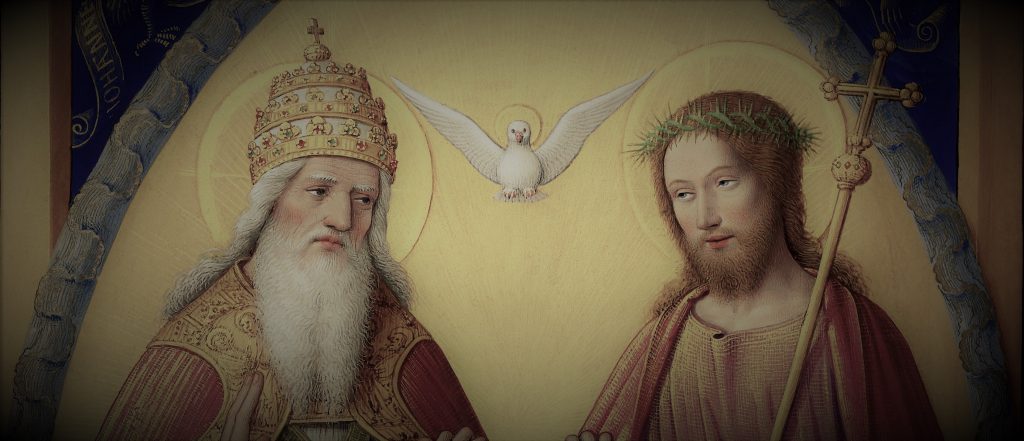
The lie of the Trinity The doctrine of the Trinity is a Catholic dogma that was officially promulgated in the 4th century AD. Although this concept is not found in the Holy Scriptures, few Christians question it. On the contrary, most of them cling to the doctrine of the Trinity like a shipwrecked man clings to a piece of wood, as they are victims of centuries-old brainwashing. In the following essay, I have attempted to highlight some arguments in favour of the Trinity which I heard or even held myself when I was still a proponent of this doctrine. It will become apparent that none of these arguments can withstand serious examination in the light of the Word of Elohim.   1) Yehoshua (Jesus) is Elohim (God) First and foremost, I would like to emphasise and assure you that Yehoshua is, without a doubt, Elohim. „1 In the beginning was the Logos, and the Logos was toward the Elohim, and Elohim was the Logos. 2 He was in the beginning toward the Elohim. […] 14 And the Logos became flesh, and he set up his tent among us, and we beheld his glory, a glory as of the only begotten Son of the Father …“ (John 1:1-2,14). „I and the Father are one“ (John 10:30). „8 Philippos says to him: Lord, show us the Father, and it is enough for us. 9 Yehoshua says to him: I am for so long time with you, and you have not known me, Philippos! He who has seen me has seen the Father. And how can you say: Show us the Father?“ (John 14:8–9). „… and out of whom according to the flesh Mashiah, who being Elohim over all, blessed for ages. Amen!“ (Romans 9:5). „And without controversy the mystery of piety is great: Elohim was manifested in the flesh, was justified by the Spirit, was seen of angels, was preached among the nations, was believed on in the world, was taken up in glory“ (1 Timothy 3:16). „But we know that the Son of Elohim has come, and has given us an understanding, so that we may know the True One. And we are in the True One, in his Son Yehoshua Mashiah. This is the True One Elohim, and the eternal life“ (1 John 5:20).   2) The Bible or tradition: which is the foundation? Let us start at the beginning: Elohim reveals himself in his Word, and anything added to or taken away from it comes from the devil (Revelation 22:18–19). I think everyone agrees with this. So why speak of the Trinity when Elohim has never revealed himself in this way in his Word? There is no mention of the Trinity. How, then, is it that this central, fundamental teaching —which even concerns the nature of Elohim— does not appear at all in the Bible? How can one explain that Paul, who says of himself, „to announce all the counsel of Elohim„ (Acts 20:27), does not say a single word about the individual persons of the Godhead? Do you not see that there is a major problem here? What you think, and what I used to think as well —namely, that the idea of the Trinity is indeed developed in the Bible, even though the word „Trinity“ itself is not found there— is not true. The conclusion that there is a Trinity in the nature of Elohim stems primarily from the legacy of a Catholic heresy. This doctrine of the Trinity did not, in fact, exist among the early Christians. This doctrine arises from the misinterpretation of certain Bible passages due to this Catholic ulterior motive, in which Protestantism is steeped.   3) Elohim is ONE So how does Elohim reveal Himself in His Word? „Shâmaʿ Yisrā’ēl YHWH elohenu YHWH ‘ecḥāḏ“ („Hear, O Israel: YHWH our Elohim is one YHWH“) (Deuteronomy 6:4).  This belief, which is based on Scripture, has been shared by all Jews to this day, and has been so since the beginning. This belief teaches us that Elohim is One („‚ecḥāḏ“), as is evident from the literal meaning of this expression. It is therefore a form of monotheism, as practised by Jews or Muslims. Yehoshua himself shared this belief in a SINGLE Elohim. „But Yehoshua answered him: The first of all the commandments is: Hear O Israel, the Lord, our Elohim, the Lord is one“ (Mark 12:29). One might now argue – as I did in the past – that the revelation of Elohim is progressive and that the Jews had not yet received this revelation of Elohim, namely the „plurality in unity“. Or that the Trinity was only revealed with Yehoshua in the New Covenant, and yet with some foreshadowing in the Old Covenant. The „Shâma’“ prayer, however, stands in stark contradiction to a plural Elohim and is a strong counter-position to any form of Trinity. It is therefore a deception, a lie, for the simple reason that the Trinity existed in pagan religions long before Judaism and Christianity.   4) The Trinity, a pagan concept The Babylonians worshipped a deity to whom Nimrod was subordinate (Genesis 10 and 11; a foreshadowing of the Antichrist). Over time, this Trinity spread to various pagan religions. From Babylon it came to Egypt, where Horus, the son of Isis and Osiris, was regarded as the reincarnation of his father Osiris; from Egypt to Greece, where the Eleusinian Mysteries existed; from Greece to Rome, and finally from Roman Catholicism to modern Protestantism and from there to the Free Churches. As debauchery progressed, these religions became polytheistic and personified the various aspects of the one true Elohim. Thus, one Elohim became several distinct gods. Catholicism, and subsequently Protestantism, thus became a link to paganism. To distort Elohim in this way signifies worldliness and is an abomination. Against this background, we can better understand what the Lord meant to tell the Hebrews when He had led them out of Egypt, where trinities were worshipped:  „Hear, O Israel! YHWH, our Elohim, YHWH

ELOHIM (God) is not a Trinity 🇬🇧 Weiterlesen »

Conversion: Receiving the Holy Spirit and walking with him 🇬🇧

1) Man Man consists of three parts: The body is man’s outer shell. The soul represents his true self, what is called the heart or, in the Bible, the “flesh”. It is the seat of emotions and defines a person’s character. It is a person’s will and makes decisions.   Through the spirit, a person can come into contact with Elohim (God), for „Elohim is Spirit“ (John 4:24), or, in the worst case, they may also come into contact with other spiritual powers. 2) Conversion When a person is converted, this takes place in five steps: first, they hear the Word of Elohim, recognise their wickedness (sins), confess them before Elohim, ask for forgiveness, and change their mindset and thus their life (confession and a plea for forgiveness towards their fellow human beings are then added to this). Now they have become a new person; their spirit is completely renewed: „Therefore if anyone is in Mashiah, he is a new creature. The old things have passed away; behold, all things have become new“ (2 Cor 5:17). Steps towards conversion a. Hearing the Word b. Recognising c. Confessing d. Asking for forgiveness from the heart e. Repenting, changing one’s mindset Once a person has been converted, they live in the knowledge that Elohim has forgiven them all the guilt they had incurred before their conversion. „18 Who is an el like you, that pardons iniquity, and passes by the transgression of the remnant of his heritage? He does not retain his anger forever, because he delights in mercy. 19 He will again have mercy on us; he will subdue our iniquities; and you will cast all their sins into the depths of the sea“ (Micah 7:18–19) In Ezekiel 36:22–36, we read that Elohim Himself brings about a person’s repentance. Yehoshua (Jesus), for example, says: „No one can come to me, except the Father who has sent me draws him …“ (John 6:44) Let us therefore look once more at the steps of conversion, bearing in mind that all power and effect proceed from Elohim („For by grace you have been saved through faith, and this does not come from you, it is the gift of Elohim“ Eph 2:8): In order for a person to recognise their wickedness at all, Elohim must have spoken to them through His Word and opened their eyes. In order for a person to confess their guilt before Elohim and ask for forgiveness, the Holy Spirit must impart humility to their heart. It is Elohim Himself who declares the convert righteous through the blood of Yehoshua Mashiah (Jesus Christ). For a person to move forward with a changed mindset, Elohim’s power is necessary.   What happens in the spiritual realm during conversion? „For the word of Elohim is living, and effective, and sharper than any twoedged sword, penetrating even to the division of soul and spirit…“ (Heb 4:12). In those who recognise the Word of Elohim as truth, the process described in the Bible verse takes place. Soul and spirit are separated from one another. The soul can no longer dominate the spirit. When the Bible says: „Then will I sprinkle clean waters upon you…“ (Ezek 36:25), this signifies a cleansing and transformation of the heart. Man is now „born from above„, just as Yehoshua explained to Nicodemus: „… Amen, amen, I say to you: Unless someone is born from above, he cannot see the Kingdom of Elohim“ (John 3:3 → read Chapter 16). Standard Bible translations use the expression „born again“, but this does not correspond to the Greek word „anothen“. This means „from a higher place, that which comes from the heavens or from Elohim, from the beginning“. The word „ano“ refers to everything that is „above, in heaven“. Thus, the converted sinner—that is, the Christian—is a person born in heaven and who now possesses his „commonwealth of citizens is in the heavens“ (Phil 3:20). He therefore no longer belongs to this world: „…But because you are not of the world and I have chosen you out of the world, because of this the world hates you“ (John 15:19). Since there are only holy people in heaven, this person is also a saint before Elohim from now on, as Yehoshua took the punishment upon himself in his stead. This is the first kind of sanctification, which the believer receives completely undeservedly, as a gift. 3) The Transformation of the Soul Changing one’s mindset—that is, the final stage of conversion—is the work of your soul. This has been wounded since childhood, indeed from the womb. Therefore, it must be healed through the true teaching, the pure Word of Elohim, and through prayer for it. However, this does not happen in an instant, as with the renewal of the spirit. From the moment of conversion, a person is born from above; they have a new spirit, yet they still carry old wounds of the heart with them. The heart, the soul, must be healed by Elohim in a lifelong process. You must separate yourself from your mindset, your customs and habits. All old passions, hurts and human pride are taken away: the „I WANT“ (ego) must become ever smaller, and character traits that do not honour Elohim must disappear (bitterness, anger, revenge, racism, envy, greed, avarice, sexual lusts and other debauchery → works of the flesh: Gal 5:19-21). Where a „vacuum“ has thus arisen in the heart, the Holy Spirit fills it with His fruits: „But the fruit of the Spirit is: Love, joy, peace, patience, kindness, goodness, faith“ (Gal 5:22). This entire process described is called sanctification: „He who acts unjustly, let him act unjustly still, and he being filthy, let him be filthy still, and he who is righteous, let him be righteous still, and he who is holy, let him sanctify himself still!“ (Rev 22:11) So whoever has been placed in the position of a saint through conversion is now in the process of being further sanctified, that is, of being perfected by Elohim: Every time you discover a

Conversion: Receiving the Holy Spirit and walking with him 🇬🇧 Weiterlesen »

Nach oben scrollen