
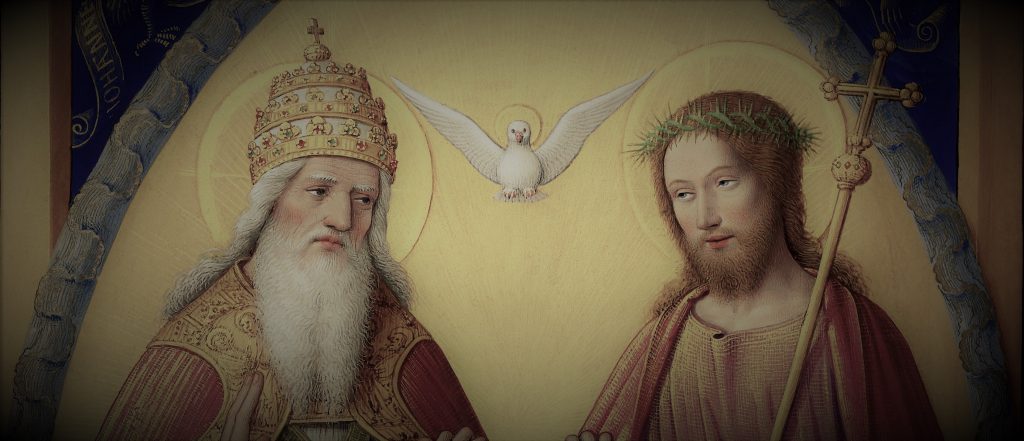
The lie of the Trinity
The doctrine of the Trinity is a Catholic dogma that was officially promulgated in the 4th century AD. Although this concept is not found in the Holy Scriptures, few Christians question it. On the contrary, most of them cling to the doctrine of the Trinity like a shipwrecked man clings to a piece of wood, as they are victims of centuries-old brainwashing. In the following essay, I have attempted to highlight some arguments in favour of the Trinity which I heard or even held myself when I was still a proponent of this doctrine. It will become apparent that none of these arguments can withstand serious examination in the light of the Word of Elohim.
1) Yehoshua (Jesus) is Elohim (God)
First and foremost, I would like to emphasise and assure you that Yehoshua is, without a doubt, Elohim.
„1 In the beginning was the Logos, and the Logos was toward the Elohim, and Elohim was the Logos. 2 He was in the beginning toward the Elohim. […] 14 And the Logos became flesh, and he set up his tent among us, and we beheld his glory, a glory as of the only begotten Son of the Father …“ (John 1:1-2,14).
„I and the Father are one“ (John 10:30).
„8 Philippos says to him: Lord, show us the Father, and it is enough for us. 9 Yehoshua says to him: I am for so long time with you, and you have not known me, Philippos! He who has seen me has seen the Father. And how can you say: Show us the Father?“ (John 14:8–9).
„… and out of whom according to the flesh Mashiah, who being Elohim over all, blessed for ages. Amen!“ (Romans 9:5).
„And without controversy the mystery of piety is great: Elohim was manifested in the flesh, was justified by the Spirit, was seen of angels, was preached among the nations, was believed on in the world, was taken up in glory“ (1 Timothy 3:16).
„But we know that the Son of Elohim has come, and has given us an understanding, so that we may know the True One. And we are in the True One, in his Son Yehoshua Mashiah. This is the True One Elohim, and the eternal life“ (1 John 5:20).
2) The Bible or tradition: which is the foundation?
Let us start at the beginning: Elohim reveals himself in his Word, and anything added to or taken away from it comes from the devil (Revelation 22:18–19). I think everyone agrees with this.
So why speak of the Trinity when Elohim has never revealed himself in this way in his Word? There is no mention of the Trinity. How, then, is it that this central, fundamental teaching —which even concerns the nature of Elohim— does not appear at all in the Bible? How can one explain that Paul, who says of himself, „to announce all the counsel of Elohim„ (Acts 20:27), does not say a single word about the individual persons of the Godhead? Do you not see that there is a major problem here? What you think, and what I used to think as well —namely, that the idea of the Trinity is indeed developed in the Bible, even though the word „Trinity“ itself is not found there— is not true.
The conclusion that there is a Trinity in the nature of Elohim stems primarily from the legacy of a Catholic heresy. This doctrine of the Trinity did not, in fact, exist among the early Christians. This doctrine arises from the misinterpretation of certain Bible passages due to this Catholic ulterior motive, in which Protestantism is steeped.
3) Elohim is ONE
So how does Elohim reveal Himself in His Word?
„Shâmaʿ Yisrā’ēl YHWH elohenu YHWH ‘ecḥāḏ“ („Hear, O Israel: YHWH our Elohim is one YHWH“) (Deuteronomy 6:4).
This belief, which is based on Scripture, has been shared by all Jews to this day, and has been so since the beginning. This belief teaches us that Elohim is One („‚ecḥāḏ“), as is evident from the literal meaning of this expression. It is therefore a form of monotheism, as practised by Jews or Muslims. Yehoshua himself shared this belief in a SINGLE Elohim.
„But Yehoshua answered him: The first of all the commandments is: Hear O Israel, the Lord, our Elohim, the Lord is one“ (Mark 12:29).
One might now argue – as I did in the past – that the revelation of Elohim is progressive and that the Jews had not yet received this revelation of Elohim, namely the „plurality in unity“. Or that the Trinity was only revealed with Yehoshua in the New Covenant, and yet with some foreshadowing in the Old Covenant. The „Shâma'“ prayer, however, stands in stark contradiction to a plural Elohim and is a strong counter-position to any form of Trinity. It is therefore a deception, a lie, for the simple reason that the Trinity existed in pagan religions long before Judaism and Christianity.
4) The Trinity, a pagan concept
The Babylonians worshipped a deity to whom Nimrod was subordinate (Genesis 10 and 11; a foreshadowing of the Antichrist). Over time, this Trinity spread to various pagan religions. From Babylon it came to Egypt, where Horus, the son of Isis and Osiris, was regarded as the reincarnation of his father Osiris; from Egypt to Greece, where the Eleusinian Mysteries existed; from Greece to Rome, and finally from Roman Catholicism to modern Protestantism and from there to the Free Churches.
As debauchery progressed, these religions became polytheistic and personified the various aspects of the one true Elohim. Thus, one Elohim became several distinct gods. Catholicism, and subsequently Protestantism, thus became a link to paganism. To distort Elohim in this way signifies worldliness and is an abomination.
Against this background, we can better understand what the Lord meant to tell the Hebrews when He had led them out of Egypt, where trinities were worshipped:
„Hear, O Israel! YHWH, our Elohim, YHWH is One“ (Deuteronomy 6:4).
Elohim was, as it were, telling them clearly: „Listen, my people, I am one and not three!“.
How else could one understand that the Gentiles had the revelation of a triune Elohim even before the Jews? Were it not they, the Jews, who were to pass on the revelation of Elohim to the nations? Were it not they to whom the words of Elohim had been entrusted (Romans 3:2)? Did they first have to be enlightened by the pagan peoples about their Elohim? This stands in direct contradiction to everything the Scriptures say.
Furthermore, one cannot claim that the pagan trinities are merely a diabolical imitation of the true heavenly Trinity, as some say. For the patriarchs and Jews had always opposed these trinities, because they believed that Elohim is One. The prophets, too, constantly warned that we should not imitate the pagan nations (Jeremiah 10).
5) Introduction of the doctrine of the Trinity in Christianity
Even a Catholic encyclopaedia admits that the doctrine of the Trinity was a later addition: „The formulation ‚one Elohim in three Persons‘ was not firmly established before the end of the 4th century, and certainly had not been fully incorporated into Christian life and its creed. But it was precisely this formulation that first laid claim to the title of a dogma of the Trinity. Among the Apostolic Fathers, one finds not even a hint of such a mentality or perspective“ (New Catholic Encyclopedia (1967), Volume XIV, p. 299).
Edward Gibbon, a well-known historian who converted to Catholicism and subsequently to Protestantism, wrote in his foreword to Peter Eckler’s book „History of Christianity“: „If it is true that Christianity triumphed over paganism, it is no less true that paganism succeeded in corrupting Christianity. The Church in Rome replaced the pure deism of the early Christians with the incomprehensible dogma of the Trinity. Numerous other pagan doctrines, invented by the Egyptians and idealised by Plato, were adopted in the same way, as they were deemed ‚worthy of belief'“.
The first to say anything approaching the „Trinity“ was Theophilus of Antioch in his work „Ad Autolycum“’ around the year 180 AD. He used the word „Τριας/Trias“, which means „three“. He used it to refer to Elohim himself. Later, Tertullian used the word „Trinity“ for the first time and fully developed the concept of the „three divine persons“. In the 4th century, under the Roman Emperor Constantine, the dogma of the Trinity was established (Council of Nicaea 325 and Council of Constantinople 381 AD). It is important to note that Constantine was a worshipper of Mithras, an offshoot of Babylonian, Egyptian and other cults. When he subsequently proclaimed Christianity (Roman Catholic) as the state religion, he merged pagan religions with the Christian faith.
Consequently, Christianity now also incorporated Christmas (the birth of Mithras), the veneration of the Virgin Mary with the Child (like Isis with Horus), the papacy (the supreme Roman priest) and, finally, the doctrine of the Trinity (a Babylonian deity)! Constantine’s aim was to unite his empire, and he knew that religion was one of the best means to that end: who would dare oppose Elohim? When he saw the growing success of the Christian faith, he successfully seized the opportunity. The Christians continued to believe they were worshipping the Elohim of the Bible, whilst the pagans found all the elements of their pagan faith reflected within it.
6) There is no distinction in Elohim
It must be stated clearly:
- The Father is the Son
„For to us a child is born, to us a son is given: and the government will be upon his shoulder: and his name will be called Wonderful, Counsellor, El Gibbor, The everlasting Father, The Prince of Peace“ (Isaiah 9:5).
- The Father is the Spirit!
„23 But the hour comes and now is, when the true worshippers will worship the Father in spirit and in truth. For the Father seeks such to worship him. 24 The Elohim is Spirit, and they worshipping him, must worship him in spirit and in truth“ (John 4:23–24).
- The Son is the Spirit!
„6 But when they had gone through Phrygia and the country of Galatia, and were forbidden of the Holy Spirit to speak the word in Asia, 7 after they were come to Mysia, they attempted to go to Bithynia, but the Spirit did not permit them“ (Acts 16:6–7).
Yehoshua was not a part or a person of Elohim, but he is the fullness of Elohim:
„8 Beware that no one takes you captive through philosophy and vain deceit, according to the tradition of humans, according to the basic principles of the world, and not according to Mashiah. 9 Because in him bodily dwells all the fullness of the deity. 10 And you are complete in him, who is the head of all principality and authority“ (Colossians 2:8–10)
So it is explicitly written in black and white, and other passages in the Bible could confirm this. It is possible that this passage in Colossians 2 was already, at that time, a rebuke of the Platonic Trinity, which was attempting to creep into the Christian community in Phrygia.
In the following, we shall consider some arguments that appear to support a „triune“ Elohim.
7) To whom did Yehoshua address his prayers?
Verses are often quoted in which Yehoshua speaks to the Father, which should actually imply that these are two distinct persons engaged in dialogue with one another.
No, that is not the case: Yehoshua is Elohim, who was revealed in the flesh. Firstly, he came to redeem us and to justify us through his sacrifice and resurrection, but he also came to show us the way (John 14:6). This is the essence of his revelation as the Son, although it should be noted that the Hebrew word for „Son“ also means „servant“ in Greek. Yehoshua, in whom the fullness of Elohim dwelt bodily, came to set an example for us of how we should live.
He came to show us the character of a Son, of a servant. That is why Paul tells us that we should be his imitators (1 Corinthians 11:1; Ephesians 5:1). Just as Paul became a Jew for the Jews (1 Corinthians 9:19–23), Elohim became a man amongst men to save mankind.
Did Yehoshua need to be baptised, especially since he is Elohim and baptism was about HIM? No, he set an example for us through his baptism (Matthew 3:15).
When speaking of baptism, the objection may arise that the voice from heaven proves that these are different persons. Not necessarily; rather, Yehoshua, as Elohim, simply caused his voice to resound from heaven to confirm his earthly mission in this body. One must see nothing else in this. An interpretation suggesting the Trinity is merely the result of centuries of Catholic conditioning. Thus Yehoshua was also able to pray to the Father to set an example that a child of Elohim might follow.
Moreover, Yehoshua subjected himself to all the limitations of human nature when he came as a human being. For if he had possessed a ‘super-body’ that was not receptive to the sensations of this world, like a superhero, for instance, there would have been nothing glorious or valuable about his sacrifice. That is why, even in his flesh, which had become like ours in every respect (Hebrews 2:17), he displayed traits of human limitation: tiredness, thirst, hunger and a range of emotions. The only difference between him and us was that he had not yielded to a single temptation. This explains why Yehoshua showed weaknesses as a human being, for example in the Garden of Gethsemane or on the cross.
What are we to make of the following words spoken by Yehoshua on the cross:
„… My El, my El, why have you forsaken me?“ (Matthew 27:46).
This statement recalls and emphasises the fulfilment of a prophetic passage from David’s Psalms.
„[…] 2 My El, my El, why have you forsaken me? why are you so far from helping me, and from the words of my roaring? 3 O my Elohim, I cry in the daytime, but thou hearest not; and in the night season, and am not silent. 4 But you are holy, O thou that inhabitest the praises of Israel. 5 Our fathers trusted in you: they trusted, and you did deliver them. […] 7 But I am a worm, and no man; a reproach of men, and despised of the people. 8 All they that see me laugh me to scorn: they shoot out the lip, they shake the head, saying, 9 He trusted on YHWH that he would deliver him: let him deliver him, seeing he delighted in him. […] 15 I am poured out like water, and all my bones are out of joint: my heart is like wax; it is melted in the midst of my bowels. […] 19 They part my garments among them, and cast lots upon my vesture. 20 But be not thou far from me, O YHWH: O my strength, haste you to help me. 21 Deliver my soul from the sword, my only one from the hand of the dog. […] 24 You that fear YHWH, praise him; […] 25 For he has not despised nor abhorred the affliction of the afflicted; neither has he hid his face from him; but when he cried to him, he heard […]“ (Psalm 22).
Yehoshua quoted this psalm as a testimony: „For these things happened so that the Scripture might be fulfilled …“ (John 19:36)
8) Is the Son ignorant?
Another point worth examining more closely concerns the Son’s apparent ignorance regarding the timing of his return:
„But of that day or hour, no one knows, not even the angels in heaven, nor the Son, except the Father“ (Mark 13:32).
It is worth noting here that it was quite simply not the Son’s task as a human being on earth to reveal when he would return. In any case, as Elohim, Yehoshua knows everything about his return, including the day and the hour – on this point everyone agrees, whether they believe in the Trinity or not. This Bible passage cannot therefore serve as an argument for the existence of distinct divine persons. It merely highlights the limitations to which Yehoshua submitted as a human being.
9) Did the apostles make a distinction between the Son and the Father?
And how do we deal with the numerous verses in which the apostles in the New Covenant apparently made a distinction between Father and Son?
„That the name of our Lord Jesus Christ may be glorified in you, and ye in him, according to the grace of our God and the Lord Jesus Christ“ (2 Thessalonians 1:12 – King James Version KJV).
In this Bible passage, the word „the“ is missing in the Greek. This is a later addition by the translator based on his personal interpretation of this verse. Translated literally, this passage reads: „…according to the grace of our Elohim and Lord Yehoshua Mashiah“.
There are no two distinct persons here!
Other Bible passages seem to bear even clearer witness to a distinction between the Father and Yehoshua. Some even speak of the „…Father of our Lord Yehoshua Mashiah“ (1 Peter 1:3).
Whilst the translation may need to be reconsidered here too, what is more important is the correct understanding of this passage. The explanation is very simple and is found in 1 Timothy 2:5:
„For Elohim is one, and the mediator between Elohim and humans is one, the human Mashiah Yehoshua“.
This passage sheds light on the distinction the apostles made between the Father and Yehoshua: they spoke of Yehoshua as a human being.
For the man „Yehoshua Mashiah“ is the means through which Elohim could be revealed to us as Father. When we speak of Yehoshua as a man, we think of his sacrifice, through which we are sanctified and may draw near to a Father-Elohim. The same applies when speaking of Yehoshua’s role as Advocate (1 John 2:1) or his role as intercessor before the Father. It is a way of reminding us how his sacrifice as a human being benefits us – indeed, before him, Elohim, himself (Hebrews 9 and 10)!
As for the Father’s superiority over the Son, this merely expresses how much higher Elohim stands in his divinity above the human form:
„5 Let this mind be in you, which is also in Mashiah Yehoshua, 6 who, being in the form of Elohim, did not consider it robbery to be equal to Elohim. 7 But he emptied himself taking the form of a slave, and was made in the likeness of human beings, 8 and being found in figure as a human being, he lowered himself, becoming obedient until death, moreover the death of the cross. 9 Therefore Elohim also has highly exalted him to supreme majesty and given him the name which is above every name, 10 so that in the name of Yehoshua every knee should bow, of existing in heaven, and of existing on earth, and things under earth, 11 and that every tongue should confess that Yehoshua Mashiah is Lord, to the glory of Elohim the Father“ (Philippians 2:5–11).
10) Do the disciples’ visions point to a Son who was distinct from the Father?
How does one explain Stephen’s heavenly vision?
„55 But he, being filled with the Holy Spirit and having his eyes fixed to heaven, saw the glory of Elohim and Yehoshua standing out of the right hands of Elohim. 56 And he said: Behold, I see the heavens opened and the Son of human standing out of the right sides of Elohim“ (Acts 7:55–56).
This is a vision. In a vision, one sees images. Yohanan, for example, had a vision of heaven in which he saw a Lamb on the throne that looked as though it had been slain. Does this mean, then, that Elohim looks like a Lamb in heaven? Certainly not. It is merely the revelation of an image representing a single aspect of Elohim.
In the royal and divine sense, „the right sides“ signifies the highest position of authority. Elohim thus presented himself to Stephen as the one who, through his incarnation and sacrifice, has conquered all powers and authorities. (Colossians 2:15)
„And I saw, and, behold, in the midst of the throne and of the four living beings, and in the midst of the elders, stood a Lamb as it had been slain, having seven horns and seven eyes, which are the seven Spirits of Elohim sent into all the Earth“ (Revelation 5:6).
Let us return briefly to the revelation of Yohanan, who saw the seven spirits of Elohim: does this mean that Elohim is a „sevennity“ (seven-fold entity)? The Bible is full of images and symbols.
11) The submission of the Son
Another Bible passage is also worth mentioning and explaining:
„24 Then the end, when he will have delivered up the kingdom to Elohim and Father, when he will have abolished all principality and all authority and power. 25 For he must reign, till he has put all enemies under his feet. 26 The last enemy that is abolished is death. 27 For he has subjected all things under his feet. But when he said that all things have been subjected, it is evident that he is excepted who did subject all things to him. 28 And when all things will be subjected to him, then will the Son also himself be subject to him who did subject to him all things, that Elohim may be the all in all“ (1 Corinthians 15:24–28).
„Mashiah“ means „the Anointed One“ and refers to the man Yehoshua, who was anointed. When all things are brought to completion and renewed, this revelation of the Son of Man as both victim and victor will also cease to exist, for all things will be united in the Father and we shall worship the Father for ever.
12) Is man a trinity?
Another argument put forward by advocates of the divine Trinity is the apparent tripartite nature of humanity.
„But may the Elohim of peace himself sanctify you perfectly, and may your whole being, spirit, and soul and body be kept blameless at the parousia of our Lord Yehoshua Mashiah!“ (1 Thessalonians 5:23)
One might ask: since man is tripartite – that is, body, soul and spirit – and was created in the image of Elohim (Genesis 1:26-27), would it then be surprising that Elohim Himself is also tripartite? Surely this is the best proof of Elohim’s Trinity.
Firstly: The „image of Elohim“ in man does not in any way imply a tripartite nature. Elohim is Spirit (John 4:24).
Furthermore, man is not tripartite, as the physical body has little significance and is merely a fleshly shell made of dust, just as a piece of wood or metal is nothing in itself. Nor is our spirit anything in itself, for without the soul it would be merely an empty „spiritual shell“. The spirit enables our soul to comprehend spiritual things; with the body we perceive physical things.
It is the soul that animates the body (physically and spiritually) and enables us to experience and feel everything around us. It is our personality, our very self.
What the Bible refers to as „the flesh“ is not necessarily the physical body, but a power of sin that dwells in our members, the old, unrenewed man, our old nature.
As bearers of the Holy Spirit, we humans would thus go beyond the Trinity: body, flesh, soul, spirit, Holy Spirit – 5 in 1! Are we, then, a „fivenity“ (fivefold entity)? Absurd.
Man is therefore ONE.
13) The plural „Elohim“
Let us consider another argument for the Trinity: the Hebrew word „Elohim“, which is in the plural. It is used in Genesis 1:1 and surely testifies to the plurality of Elohim and his Trinity? In truth, this is quite simply a „plural of majesty“.
This „pluralis majestatis“ is the use of the second-person plural form (you) to refer to a single person as an expression of power. In German, too, the second-person plural (Sie) is used to address a single person, as well as in French with „vous“ (second person plural) instead of „tu“ (second person singular).
This is a sign of respect and not proof that we are speaking to several people at once. In Hebrew, there are no comparative or superlative forms (very great, the highest, more than, …). Therefore, the plural is used to give words greater expressiveness. The singular „Eloah“ is thus made more meaningful by the plural „Elohim“.
14) Does the expression ‘ecḥāḏ’ indicate a composite unity?
Another argument would be that the Hebrew word „ecḥāḏ'“, translated as „one“ (or „a single one“ depending on the version) in the biblical passage Deuteronomy 6:4, implies a composite unity. Here, reference is also made to Genesis 2:24, where this same word is used for the man and woman who become „one flesh“. Two become one („ecḥāḏ'“). The creation account also states:
„And the evening appeared, and the morning appeared: Day one“ (Genesis 1:5).
Here, two periods become ONE („ecḥāḏ'“) day. For proponents of the Trinity, the unity of Elohim therefore consists of three composite parts.
According to them, the word „yahid“ would rather be used to express that Elohim is indivisible in the strict sense. However, this Trinitarian interpretation does not hold water and is quite incorrect. In Hebrew, „ecḥāḏ'“ means „one“ as a number (1, 2, 3, 4, …).
We see this also when counting the days of creation. All the other days also have an evening and a morning (Genesis 1:8, 13, 19, 23, 31). This does not, however, mean that the Hebrew words for two, three, four, etc., are to be regarded as compound plurals. Nor can „ecḥāḏ'“ in Genesis 1:5 be regarded as a compound unit.
So when „ecḥāḏ“ is used to describe the union of man and woman, it is only to emphasise the unity they are meant to form. Nothing should be able to separate them (Matthew 19:6). To start from “one” and make two or three out of it would be foolish, would distort the meaning of this Bible passage and work against Elohim’s purpose.
As for the word „yahid“, it means „one“ in relation to an external thing: unique, alone. For example, one speaks of the only son in Genesis 22:2. He is not described as unique by nature, but as the only son who has no siblings. Here, „yahid“ is used.
Due to the influence of the doctrine of the Trinity, many Bible editions also mistranslate the passage in Deuteronomy 6:4: „Hear, O Israel! YHWH, our Elohim, YHWH is One“ or „Hear, O Israel! YHWH, our Elohim, YHWH alone“, to assert that there is no other YaHWeH/LORD.
The Hebrew Bible, however, whose translators were unfamiliar with the Trinity, states: „YHWH is One“.
Furthermore, the word „yahid“ derives from the root „yahad“ and means: to connect, to unite, to bring together. The argument put forward by advocates of the Trinity, „ecḥāḏ'“ versus „‘yahid“, is thus completely overturned.
15) What is Elohim?
So how are the different designations to be understood: Father, Son, Holy Spirit? It is very simple: these are different revelations of the same Elohim, arising from different situations and perspectives.
„1 Elohim having spoken many times and in many ways in time past to the fathers by the prophets, 2 has in these last days spoken to us in the Son, whom he has appointed heir of all things, through whom also he made the ages“ (Hebrews 1:1–2).
A family man is at the same time a husband, head of the family, son of his own father, work colleague, etc. Yet he remains one person. So it is with Elohim.
Elohim revealed Himself in Yehoshua Mashiah as a Son who submits to the Father. During His ministry as Son, He gave us His revelation as Father, and when He had finished His ministry on earth, He revealed Himself as the Holy Spirit. In the beginning, he presented himself as the Creator; to the disciples, he revealed himself as the Light, the Alpha and Omega, the Lamb, the Lion of Judah, the Word of Elohim, and so on.
If each of these aspects were a separate person, one would never reach the end, for Elohim is infinite. When we are with him, we can contemplate him eternally and discover a new aspect of his divinity every moment.