
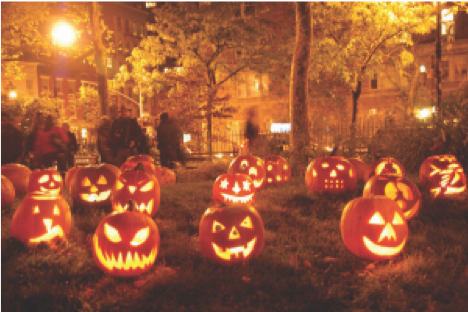
From a very young age, children are exposed to the rituals of celebrations that punctuate the year, whether with their families or in the community. But what is a celebration? From the Latin „festa“, it is a religious or civil solemnity commemorating an important event. Here we will focus more specifically on celebrations of a religious nature. We have all participated in these celebrations to some extent during our childhood. Indeed, who has never decorated a Christmas tree and waited excitedly for Father Christmas to bring us presents, provided we had been good? Who has never hunted for chocolate eggs at Easter or witnessed a parade of costumes, each more frightening than the last, at Halloween? As Christians, it is legitimate to ask what influence all these celebrations have on children and what the Bible says about them. To do this, let’s take a closer look at the origins of some of the most widespread celebrations in our societies and what lies behind them.
1) Halloween
Halloween, or rather „All Hallows Eve“, meaning „the eve of All Saints‘ Day“, originated 2,500 years ago in north-western Europe, more precisely among the Celts and Gauls, under the name of Samhain (November in Gaelic). This ritual festival was celebrated on a full moon night – as the Celtic calendar is lunar – to welcome in the new year, which ended at the end of October. It should be noted that the Celtic year was divided into two periods due to the mild and humid climate of Western Europe: a dark half beginning on 1 November at „Samhain“ and a light half beginning on 1 May at „Beltane“.
The Samhain festival lasted seven days, three days before and three days after the full moon. It was compulsory, regardless of a person’s social background, under penalty of divine punishment. It was accompanied by a feast consisting of an abundance of pork (this animal was considered a destructive and fearsome deity and was believed to confer immortality), beer, mead (a sweet alcoholic drink fermented from water and honey) and wine.
Drunkenness was the order of the day, accompanied by songs, ritual games involving sacrifices and the lighting of a new fire. In fact, all Gauls had to extinguish the fire in their hearths so that the druids could light a new one to celebrate the coming year. This festival was intended to create bridges between the world of the living and the world of the dead, where everyone was invited to come to the other side. The deceased then lost their gift of invisibility. This event was also political, military and commercial, as contracts could be established there and the king who presided over the ceremony renewed his powers.
Later, with the Roman conquest, the harvest festival in honour of the Etruscan goddess Pomona was added to Samhain. Subsequently, Christianity, which rejected pagan rituals, eliminated it in favour of All Saints‘ Day, which was established in 837 at the instigation of Pope Gregory IV, on 1 November in the liturgical calendar. Halloween continued to be celebrated on 31 October despite this.
A festival surrounded by legends
In the mid-19th century, following a potato blight that affected their country, the Irish immigrated to the United States, bringing with them tales and legends such as that of Jack O’Lantern, a stingy, alcoholic man who made a deal with the devil not to take his soul. On the day of his death, unable to go to heaven because of his bad behaviour, Jack went to hell but was expelled because of his pact with the devil. However, as the darkness was very deep, he obtained an ember which he placed in a turnip he was eating to use as a lantern. Thus he found himself wandering for eternity in the darkness.
As they migrated, the Irish abandoned turnips in favour of pumpkins, which were easier to find on American soil. At the end of the 19th century, this festival became a national holiday in the United States, with the addition of the famous trick-or-treating tradition. This festival arrived in France in the late 1990s.
Let us now turn our attention to Christmas and its origins.
2) The 25 December
Christmas, which may come from the Gaulish „noio hel“, meaning „new sun“, is celebrated on 25 December. Why? Because originally, between 20 and 23 December, the winter solstice occurs in the northern hemisphere, „sol stare“ in Latin, which means the sun stops (rising or setting), and where the days become shorter and shorter, giving way to the anxiety of darkness, the fear that the sun will not return; hence the need to invoke gods and deities to make it reappear.
This pivotal period of the year was therefore associated with many pagan beliefs relating to fertility, motherhood, procreation and astronomy. In order to combat the darkness, the Celts lit large fires. In ancient times, the Persians celebrated the birth of Mithra, elohîm (god) of mysteries, the sun of Justice, on 25 December. This elohîm of life and light, born of a virgin, fought against darkness and evil, and a bull was sacrificed to him.
In Egypt, it was Aion, the son of the elohîm Osiris, who was worshipped. He was the symbol of the reborn sun. As for the goddess Isis, often depicted crouching with the child Horus in her arms, she is reminiscent of the Virgin Mary holding the child Yehoshua (Jesus) on her lap. The Romans honoured Saturn, elohîm of time, agriculture and fire, during the Saturnalia (17 to 24 December), but also the unconquered sun, celebrated on 25 December as the birthday of the Sun, which was Christianised in 325 in the West. The elohîm of fire or sun among the Babylonians was called Thammuz, or Moloch or Baal. These titles were the different names of Nimrod (Genesis 10:8-9), considered the father of all Babylonian elohîm.
During the Saturnalia (17 to 24 December), social classes mingled, slaves commanded their masters, masters served their slaves at table, and the greatest licence prevailed. This greatly displeased the Catholic religious authorities, who decided in the 4th century, with Pope Liberius and Roman Emperor Constantine, to adopt the symbolic date of 25 December to mark the birth of Yeshua in order to put an end to these pagan festivals.
a) Who is Father Christmas and why does he give presents?
In Scandinavian mythology, the Yule celebrations were associated with the winter solstice. This is the time of year when Heimdallr, elohîm of light and the Moon, returned to see his children. He visited every home to reward them if they had behaved well during the year. He would leave a present in their stockings, but for those who had behaved badly, their stockings were filled with ashes.
Among the Vikings, a man dressed in a large cape was supposed to represent Odin, the Scandinavian elohîm of war and ruler of the Norse gods. He visited homes to ask if everything was alright and offered treats to well-behaved children.
In Norway in the 10th century, King Håkon I of Norway is said to have decided that the Midtvintersblot festival (a midwinter festival where the elf Julenisse distributed gifts) would be celebrated at the same time as Christian Christmas.
In Christian tradition, according to the Catholic Church, gifts symbolised the offerings made by the Three Wise Men to Yehoshua (gold, myrrh and frankincense). However, the exchange of gifts between friends is a characteristic of the Saturnalia that was adopted by Christians. Thus, today’s Father Christmas is a mix of the deities of the time who only give gifts to „well-behaved“ children….
b) Where does the Christmas tree ritual come from?
The Celts assigned a tree to each lunar month. For the month of December, it was the spruce, which was placed inside homes for the winter solstice and decorated with sweets. Trees participating in winter solstice celebrations were revered by various civilisations.
The modern Christmas tree comes from Germany, which continued this tradition received from the Romans, who in turn received it from the Babylonians and Egyptians. For the record, Babylonian legend claimed that from the stump of a dead tree, representing the death of Nimrod, a green tree grew, symbolising the reincarnation of Nimrod in the person of Thammuz. Thus, this evergreen tree was worshipped by the Babylonians.
Among the Druids, it was the oak that was sacred, while for the Egyptians it was the palm tree, and for the Romans it was the fir tree, which was decorated with red fruits during the Saturnalia and where it was customary to place an offering.
In the old calendar of saints, 24 December was dedicated to Adam and Eve, and the mystery of original sin was represented by a tree decorated with apples. Gradually, it became the Christmas tree, bringing light and salvation.
3) The origins of Easter
Easter with an „s“ symbolises the celebration of spring after long winter months during the spring equinox between 20 and 21 March in the West. This joy of renewal was the subject of pagan festivals in honour of the resurrection of the elohîm Thammuz, brought back from the underworld by his wife and mother, Ishtar (Easter in English). This Babylonian goddess became Astarte in Phoenicia, Eostre (from Eos: dawn) or Aphrodite in Greece, Ashtoreth among the Jews and Ostara in Germany (which comes from ost: east, direction of dawn).
This goddess, associated with the planet Venus, rose before the sun and set after it, and was said to love the sun elohîm. This fertility deity, worshipped in spring at the time of the rebirth of life, was the subject of a custom that was not highly recommended, according to historian Will Durant (1885-1981), based on a story by Herodotus which states that ‘every native woman is obliged once in her life to sit in the temple of Venus (Easter) and have sexual relations with a stranger’. A veritable invitation to debauchery… But let us now look at the symbols associated with this festival.
a) Lent
This forty-day period of abstinence was once observed in honour of the pagan elohîm Osiris, Adonis and Thammuz, according to John Landseer (1769-1852), an English engraver who researched the hieroglyphics engraved in Chaldea, Egypt and Canaan. Alexander Hislop (1807-1865), an English pastor, asserts that „The forty days of abstinence during Lent are a practice borrowed directly from the worshippers of the Babylonian goddess (Ishtar, editor’s note). Such a period of forty days in spring is still observed by the Yezidis or devil worshippers of Kurdistan, who inherited this practice from their former masters, the Babylonians…“
Lent has therefore nothing to do with the Bible!
b) The eggs
Eggs are a powerful symbol of rebirth, used during this spring festival. James Bonwick (1817-1906), writer of historical and educational facts, states that „Eggs were hung in Egyptian temples. […] The ordinary egg, the emblem of fertile life, coming out of the mouth of the great god of Egypt. The mystical egg of Babylon, which gave birth to Venus, Ishtar, fell from the sky into the Euphrates. Eggs were sacred offerings in Egypt, as they still are today in China and Europe. Easter, or spring, was the season of birth, whether earthly or heavenly“.
This tradition is not new; it has evolved over the centuries. In fact, a few decades ago, during Lent, it was forbidden to eat eggs. They were kept to be blessed and painted on Easter Day, then given to children. Depending on the country, the eggs were decorated in different ways.
The custom of giving chocolate eggs at Easter appeared in the 18th century.
c) The rabbit
The rabbit, and more specifically the hare, is a symbol of fertility in ancient Egypt, a symbol that was later preserved in Europe and incorporated into the Easter celebrations. Indeed, “ in Germany and Austria, small nests containing eggs, pastries and sweets are hidden in various places, and children believe that the Easter bunny, which is also very popular in these countries, has laid eggs and brought sweets’. Similarly, ‘the Easter bunny has its origins in pre-Christian pagan fertility rites. It has never been attributed any religious symbolism. However, it has acquired this valuable role in the celebration of Easter as the producer of Easter eggs for children in many countries“, says Francis Weiser, a Catholic priest.
d) Bells
Chocolate bells represent church bells that stop ringing from Maundy Thursday to Holy Saturday, commemorating the death of Yeshua. It is said that these bells left for Rome, from where they return on Saturday night, ringing again to celebrate the resurrection of Yeshua and scattering sweets for children along the way.
e) The choice of the date of Easter
The Council of Nicaea set Easter on the first Sunday after 21 March, which corresponds to the full moon of the spring equinox, which was originally set in the Julian calendar on 25 March, the feast day of the Babylonian goddess Ishtar. However, at the time of the Council of Nicaea in 325, it was observed that the equinox fell on 21 March.
The four-day difference between the two calendars was due to an error in the Julian calendar, which was corrected with the adoption of the Gregorian calendar (by Pope Gregory XIII). However, the day of the equinox varies and can also fall on 20 March or 22 March.
To remedy this problem, the council’s decision was unanimous: Easter was to be observed on the first Sunday after the spring equinox, regardless of the date. It was to be celebrated on the same Sunday throughout the world, and no one was to follow the Jewish date (the 14th day of the month of Nissan).
Here is an excerpt from Constantine’s letter to the churches at the end of the council:
„At this assembly, the question concerning the most holy day of Easter was discussed, and it was resolved, by unanimous judgment of all those present, that this feast should be observed by all, everywhere and on the same day … And above all, it seemed unworthy that the celebration of this most holy feast should follow the practice of the Jews, who have defiled their hands in an ungodly manner by a great sin… for we have received a different way from our Lord. And I myself have committed myself to ensuring that this decision meets with the approval of your wisdom, in the hope that your wisdom will gladly accept this practice, which is already observed in the city of Rome and in Africa, throughout Italy and in Egypt… and this by unanimous judgement.“ (The New Catholic Encyclopedia Vol 5, p.228).
These writings demonstrate beyond doubt that it was the authority of the Church of Rome, and not the Word of Elohim, that determined the date on which Easter was to be observed.
4) What the Bible says
The Word tells us that faith comes from what we hear, and what we hear comes from the Word of Elohim (Romans 10:17), but if children constantly hear or see things that are contrary to the Word of Elohim, their vulnerable minds will accept them as true. Thus, given the origins of Halloween, we see that it introduces children to witchcraft. However, the Bible warns us against practices that are contrary to the Word of Elohim, particularly those of the Druids and Celtic priests.
„10 There will not be found among you any one that makes his son or his daughter to pass through the fire, or that useth divination, or an observer of times, or an enchanter, or a witch, 11 Or a charmer, or a consulter with familiar spirits, or a wizard, or a necromancer. 12 For all that do these things are an abomination to YHWH: and because of these abominations YHWH your Elohim does drive them out from before you“ (Deuteronomy 18:10-12).
„13 So Shaul died for his transgression which he committed against YHWH, even against the word of YHWH, which he kept not, and also for asking counsel of one that had a familiar spirit, to enquire of it; 14 And enquired not of YHWH: therefore he slew him, and turned the kingdom to David the son of Isai“ (1 Chronicles 10:13-14).
Furthermore, the Word condemns sorcery, stating: „Bless those persecuting you, bless and do not curse“ (Romans 12:14).
As for orgies and drunkenness, the apostle Paul tells us: „And do not get drunk with wine, in which is debauchery, but be filled with the Spirit“ (Ephesians 5:18).
Finally, the Word shows us that Elohim is not the Elohim of the dead but of the living:
„… Elohim is not the Elohim of the dead, but of the living„ (Matthew 22:32).
As for the Christmas holiday, there is no mention in the Bible of Yehoshua’s birth on 25 December. This pagan festival was „christianised“ by the Roman Catholic Church, but its pagan foundations mean that its fruits pervert the minds of children, who are conditioned to covet and idolise, and encouraged to desire ever more of the ephemeral goods of this world. Here is what the Bible says on this subject.
„Because all that is in the world, the lust of the flesh, and the lust of the eyes, and the pride of life, is not out of the Father, but is out of the world“ (1 John 2:16).
„Beloved, I exhort you as strangers and sojourners, to abstain from carnal desires, that fight against the soul“ (1 Peter 2:11).
„11 For the grace of Elohim that brings salvation to all human beings has appeared. 12 It teaches us that by denying impiety and worldly lusts, we should live in the present age discreetly, righteously and piously“ (Titus 2:11-12).
„You adulterers and adulteresses! Do you not know that the friendship of the world is enmity of Elohim? Whoever therefore want to be a friend of the world is set enemy of Elohim“ (James 4:4).
„Therefore, my beloved, flee from idolatry“ (1 Corinthians 10:14).
„For this you know, that no male prostitute, nor unclean person, nor covetous man, who is an idolater, has any inheritance in the Kingdom of Mashiah and of Elohim“ (Ephesians 5:5).
The Easter holiday, on the other hand, is a true Catholic deception, which has nothing to do with the Jewish Passover that Elohim instituted. Let us remember that every year, on the fourteenth day of the month of Nissan, the Israelites had to sacrifice a male lamb without blemish and eat it between two evenings. This perpetual law was a celebration of the deliverance that the Lord had granted them in Egypt after four centuries of slavery. All this took place under the Law, yet the Bible tells us that the ceremonial law was a shadow of things to come (Colossians 2:17).
„The next day, Yohanan sees Yehoshua coming to him, and he says: Behold the Lamb of Elohim who takes away the sin of the world„ (John 1:29).
Yehoshua ha Mashiach was that lamb who was to be slain on the cross as a living sacrifice for the deliverance of the sins of all mankind. His blood was shed to cleanse us and thus save us from death, like the blood of the lamb that was once on the doors of the Israelite houses. By accepting Yeshua into our lives, we must strive to live out this deliverance at every moment. There is no need to set aside a specific day to remember the work of the cross, much less to celebrate the Jewish Passover, for Yehoshua ha Mashiach (Jesus Christ) is our Passover.
„7 Therefore cleanse out the old leaven, so that you may be a new lump, as you are unleavened, for also Mashiah, our passover was sacrificed for us. 8 Therefore let us celebrate the feast, not with old leaven, nor with the leaven of malice and wickedness, but with the unleavened bread of sincerity and truth“ (1 Corinthians 5:7-8).
Conclusion
After examining the origins of all these festivals, we find that they have no biblical basis. Their symbols are not Christian; on the contrary, they are based on superstitions and human traditions far removed from the Word of Elohim. Our children are completely unaware of the true history behind these festivities. It is adults who encourage them to attach importance to these celebrations and to give credence to lies. Elohim rejects anything that is contrary to his holiness; he does not compromise. Beyond the customs derived from pagan religions, these festivities are also an opportunity for large companies to make a lot of money by exciting people’s greed.
It is therefore time to return to the Word of Elohim and teach our children according to the truth of this Word so that they may be enlightened and not compromise themselves in this present age.
„Train up a child in the way he should go: and when he is old, he will not depart from it“ (Proverbs 22:6).
„And the fathers, do not irritate your children, but nurture them to maturity by education and admonition of the Lord“ (Ephesians 6:4).
„Woe to you, O land, when your king is a child, and your princes eat in the morning!“ (Ecclesiastes 10:16).