

1) Man
Man consists of three parts:
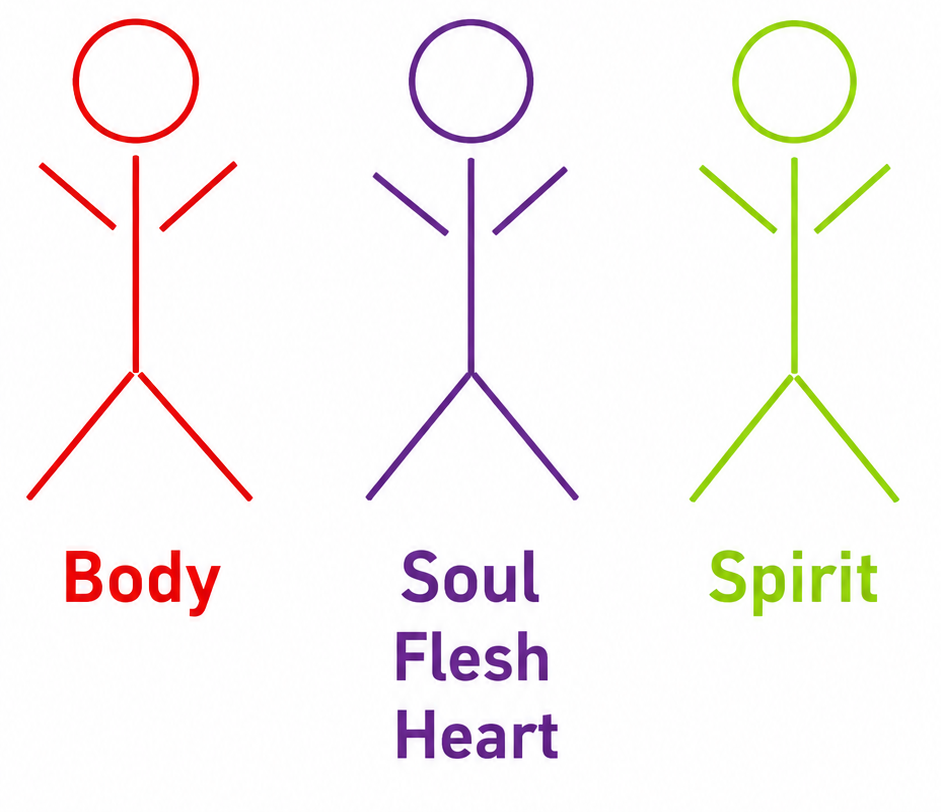
- The body is man’s outer shell.
- The soul represents his true self, what is called the heart or, in the Bible, the “flesh”. It is the seat of emotions and defines a person’s character. It is a person’s will and makes decisions.
- Through the spirit, a person can come into contact with Elohim (God), for „Elohim is Spirit“ (John 4:24), or, in the worst case, they may also come into contact with other spiritual powers.
2) Conversion
When a person is converted, this takes place in five steps: first, they hear the Word of Elohim, recognise their wickedness (sins), confess them before Elohim, ask for forgiveness, and change their mindset and thus their life (confession and a plea for forgiveness towards their fellow human beings are then added to this). Now they have become a new person; their spirit is completely renewed:
„Therefore if anyone is in Mashiah, he is a new creature. The old things have passed away; behold, all things have become new“ (2 Cor 5:17).
Steps towards conversion
- a. Hearing the Word
- b. Recognising
- c. Confessing
- d. Asking for forgiveness from the heart
- e. Repenting, changing one’s mindset
Once a person has been converted, they live in the knowledge that Elohim has forgiven them all the guilt they had incurred before their conversion.
„18 Who is an el like you, that pardons iniquity, and passes by the transgression of the remnant of his heritage? He does not retain his anger forever, because he delights in mercy. 19 He will again have mercy on us; he will subdue our iniquities; and you will cast all their sins into the depths of the sea“ (Micah 7:18–19)
In Ezekiel 36:22–36, we read that Elohim Himself brings about a person’s repentance.
Yehoshua (Jesus), for example, says: „No one can come to me, except the Father who has sent me draws him …“ (John 6:44)
Let us therefore look once more at the steps of conversion, bearing in mind that all power and effect proceed from Elohim („For by grace you have been saved through faith, and this does not come from you, it is the gift of Elohim“ Eph 2:8):
- In order for a person to recognise their wickedness at all, Elohim must have spoken to them through His Word and opened their eyes.
- In order for a person to confess their guilt before Elohim and ask for forgiveness, the Holy Spirit must impart humility to their heart.
- It is Elohim Himself who declares the convert righteous through the blood of Yehoshua Mashiah (Jesus Christ).
- For a person to move forward with a changed mindset, Elohim’s power is necessary.
What happens in the spiritual realm during conversion?
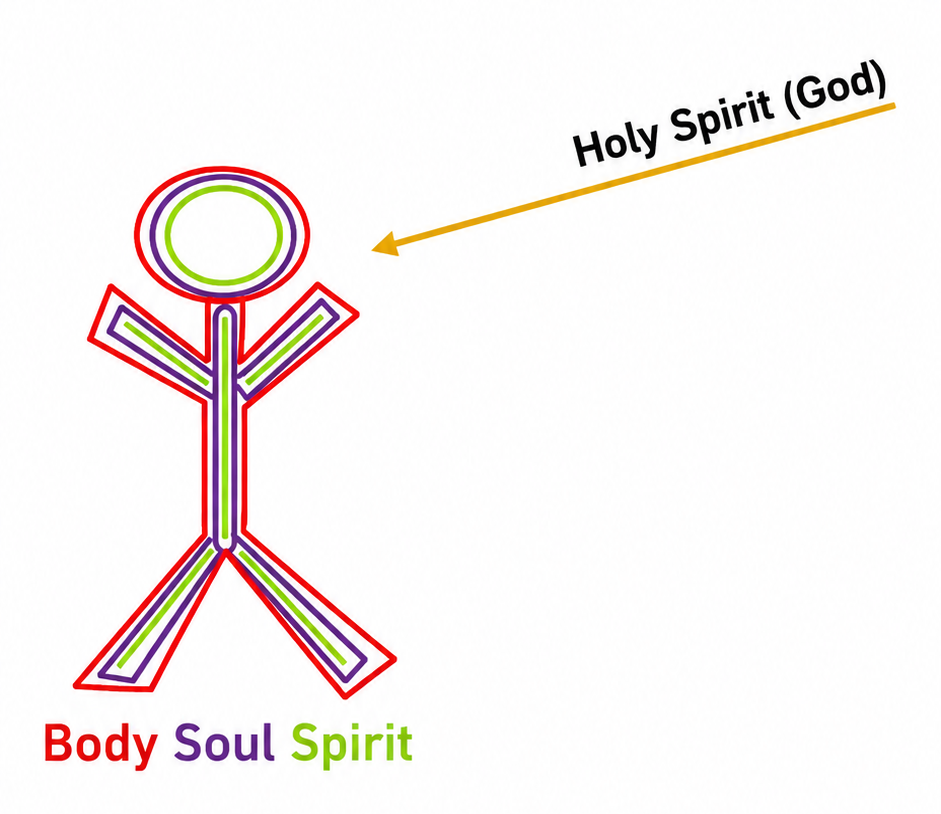
„For the word of Elohim is living, and effective, and sharper than any twoedged sword, penetrating even to the division of soul and spirit…“ (Heb 4:12).
In those who recognise the Word of Elohim as truth, the process described in the Bible verse takes place. Soul and spirit are separated from one another. The soul can no longer dominate the spirit. When the Bible says:
„Then will I sprinkle clean waters upon you…“ (Ezek 36:25), this signifies a cleansing and transformation of the heart.
Man is now „born from above„, just as Yehoshua explained to Nicodemus:
„… Amen, amen, I say to you: Unless someone is born from above, he cannot see the Kingdom of Elohim“ (John 3:3 → read Chapter 16).
Standard Bible translations use the expression „born again“, but this does not correspond to the Greek word „anothen“. This means „from a higher place, that which comes from the heavens or from Elohim, from the beginning“. The word „ano“ refers to everything that is „above, in heaven“. Thus, the converted sinner—that is, the Christian—is a person born in heaven and who now possesses his „commonwealth of citizens is in the heavens“ (Phil 3:20). He therefore no longer belongs to this world:
„…But because you are not of the world and I have chosen you out of the world, because of this the world hates you“ (John 15:19).
Since there are only holy people in heaven, this person is also a saint before Elohim from now on, as Yehoshua took the punishment upon himself in his stead. This is the first kind of sanctification, which the believer receives completely undeservedly, as a gift.
3) The Transformation of the Soul
Changing one’s mindset—that is, the final stage of conversion—is the work of your soul. This has been wounded since childhood, indeed from the womb. Therefore, it must be healed through the true teaching, the pure Word of Elohim, and through prayer for it. However, this does not happen in an instant, as with the renewal of the spirit. From the moment of conversion, a person is born from above; they have a new spirit, yet they still carry old wounds of the heart with them.
The heart, the soul, must be healed by Elohim in a lifelong process. You must separate yourself from your mindset, your customs and habits. All old passions, hurts and human pride are taken away: the „I WANT“ (ego) must become ever smaller, and character traits that do not honour Elohim must disappear (bitterness, anger, revenge, racism, envy, greed, avarice, sexual lusts and other debauchery → works of the flesh: Gal 5:19-21). Where a „vacuum“ has thus arisen in the heart, the Holy Spirit fills it with His fruits:
„But the fruit of the Spirit is: Love, joy, peace, patience, kindness, goodness, faith“ (Gal 5:22).
This entire process described is called sanctification:
„He who acts unjustly, let him act unjustly still, and he being filthy, let him be filthy still, and he who is righteous, let him be righteous still, and he who is holy, let him sanctify himself still!“ (Rev 22:11)
So whoever has been placed in the position of a saint through conversion is now in the process of being further sanctified, that is, of being perfected by Elohim: Every time you discover a weakness within yourself and change your course accordingly, that constitutes a change, a conversion and sanctification in that area.
When you obey the Holy Spirit in every situation, the works of the flesh die. There is no Christian who does not fall into sin again after their conversion. As long as we are on earth, we are imperfect. What is important is that we run immediately to the Father and repent when the Holy Spirit convicts us of sin. King David also had this attitude, which is why Elohim described him as a „man after YHWH’s own heart“:
„…YHWH has sought him a man after his own heart…“ (1 Sam 13:14)
4) Preserving His Conversion
The Test of Love
„Yehoshua answered and said to him: If someone loves me, he will keep my word, and my Father will love him, we will come to him and we will make our dwelling with him“ (John 14:23).
The test of love that Elohim sets before us is indispensable. We must pass it again and again throughout our lives. In certain situations, you are faced with a choice: Elohim or the world. And every time you choose Elohim, a part of your flesh is put to death.
At the beginning, immediately after conversion, you are passionate for Elohim. Later, you are tested. The fleshly desires return. But Elohim says: „You shall love me unconditionally“.
Peter, too, was asked three times by the Lord Yehoshua: „Do you love me?“ (John 21:15–17).
The danger: The quenching of the Holy Spirit
We have understood that the transformation of the heart is a daily, lifelong struggle. It is a path of sanctification. The further one drifts away from the Word of Elohim, the more the old desires of the heart resurface. The Holy Spirit is grieved. He warns you. When you walk with Elohim, the Holy Spirit snatches you away from evil things. When the Holy Spirit is grieved, you have allowed other things into your heart, such as pride.
„And do not grieve the holy Spirit of Elohim, by whom you have been marked with a seal for the day of redemption“ (Eph 4:30).
We are to live according to the Spirit. If we do not listen to Him, or listen to Him less and less, it is like two people walking together, and one person slowly strays from the path and thus also from the other. This also happened to King Saul, who simply would not heed Elohim’s commands, that is, the Holy Spirit.
In 1 Sam 16:14 it says: „But the Spirit of YHWH departed from Shaul, and an evil spirit from YHWH troubled him“.
Saul was still king, so he still had this anointing, but he had strayed from the path and was now led by another spirit. Many pastors, just like Saul, have suffered shipwreck. They started well but have strayed from the path. You sense that the Holy Spirit is grieved, and the more you resist, the further you drift in the opposite direction. When the Holy Spirit leaves you (is quenched), something else takes hold of you.
„Do not quench the Spirit!“ (1 Thessalonians 5:19).
Many people have experienced Elohim and accepted Yehoshua. Yet they still harbour fleshly desires and resist dying with Yehoshua. They do not want to take up their cross and let their old self die. Because of their stubborn nature, they refuse to accept the corrections of Yehoshua Mashiah in their lives. People who were once converted go to hell because they did not resist evil.
„You have not yet resisted until blood, fighting against sin“ (Heb 12:4).
They have failed the test of love.
Elohim’s presence preserves us until the end
How can one rid oneself of carnal desires/works of the flesh that keep recurring, e.g. outbursts of anger?
1 John 1:8–9 offers the key: „8 If we say that we have no sin, we deceive ourselves, and the truth is not in us. 9 If we confess our sins, he is faithful and righteous that he forgives us the sins, and cleanse us from all unrighteousness“.
- a) First and foremost, therefore, it is important to admit and confess one’s weaknesses when the Lord points them out to us. The worst thing is to justify oneself. For this is precisely what the pride within you desires. But who are you to wish to justify yourself? Instead, humility is required.
Phil 2:1–9: „1 If therefore any consolation in Mashiah, if any persuasive address of love, if any fellowship of the Spirit, if any bowels and mercies, 2 fulfill my joy, that you may have the same mind, having the same love, being of one soul, thinking in oneness, 3 nothing according partisanship or vainglory; but in humility let each esteem others superior than themselves. 4 Look not each on his own things, but each also on the things of others. 5 Let this mind be in you, which is also in Mashiah Yehoshua, 6 who, being in the form of Elohim, did not consider it robbery to be equal to Elohim. 7 But he emptied himself taking the form of a slave, and was made in the likeness of human beings, 8 and being found in figure as a human being, he lowered himself, becoming obedient until death, moreover the death of the cross. 9 Therefore Elohim also has highly exalted him to supreme majesty and given him the name which is above every name“.
- b) We must believe that Yehoshua has forgiven our sins. If we keep falling into the same sin, we must ask Elohim about the root of our problem and he will reveal it.
- c) On the day you were converted, no one convinced you except Yehoshua Christ alone. Only He can save you from your flesh. No one must steal our conviction that we love Elohim and are children of Elohim. When I have the assurance that no one can separate me from the love of Elohim, I find it easy to lay things before Elohim. „Elohim, help me“ is then my frequent thought. I then do everything I can to spend time with Elohim. Demons will flee because they recognise the assurance in my heart. They will immediately heed the declaration: „I cast you out of my life in the name of Yehoshua the Messiah„, or they will even leave without a word being spoken. The confidence that my life is in Elohim’s hands, no matter what happens, is also expressed in the following verses from Romans 8:
„1 Therefore now no condemnation to those in Mashiah Yehoshua, walking not according to the flesh, but according to the Spirit. […] 28 And we know that all things work together for good to them that love Elohim, to them being called according to his purpose. […] 38 For I am persuaded that neither death, nor life, nor angels, nor principalities, nor powers, nor things present, nor things to come, 39 nor height, nor depth, nor any other creature, will be able to separate us from the love of Elohim, which is in Mashiah Yehoshua our Lord.“
It is recommended that you read the whole of Romans 8 in detail.