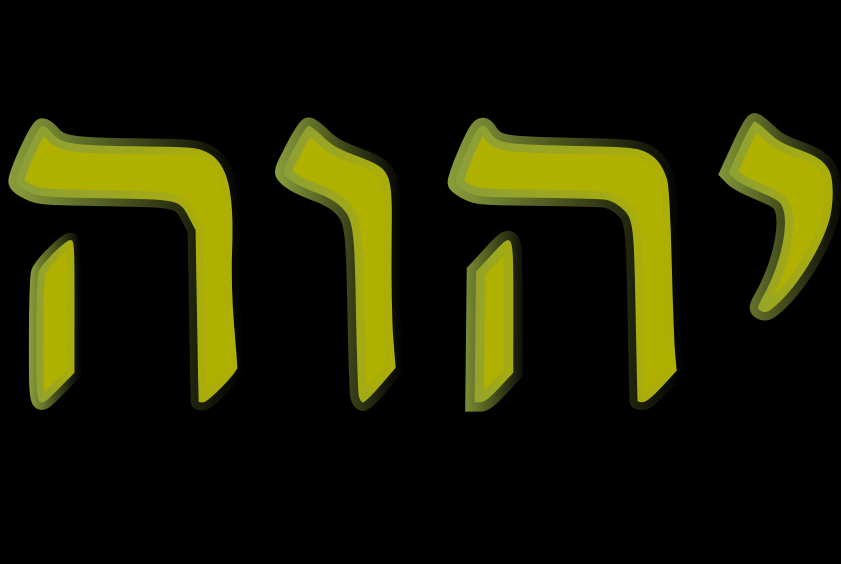
The revelation of the name of Elohim
In Jewish tradition, names have great significance. They are more than just a distinguishing feature between different individuals. A name embodies the identity of the person who bears it and says a lot about their mission. For example, the name „Isaiah“ comes from the Hebrew „Yesha’yah“ and means „YHWH has saved“. Indeed, the prophet Yesha’yah described the salvation of YHWH like no other, and his book is rich in messianic prophecies.
Yehoshua (Jesus) was no exception to this rule. The names attributed to the Lord confirm his mission, his offices and his divine nature.
1) Yehoshua Mashiah is YHWH
In order to understand the meaning of the name Jesus (Yahweh is salvation), it is extremely important to first understand the meaning of the Tetragrammaton (the four letters of the name of Elohim: YHWH). This name occurs most frequently in the Tanakh [1]. The Tetragrammaton YHWH is contained in the name ‚Jesus‘, which comes from the Hebrew „Yehoshua“, meaning „YHWH is salvation“. The four letters that make up this name have a very prophetic meaning.
a) Yod
Yod י is the tenth letter of the Hebrew alphabet. It comes from ‚yad‘, which means ‚hand‘. This letter is the smallest in the alphabet. However, it is the one that has the most power. For it is the hand of Elohim [2] that has formed us.
„[Yod] Your hands have made me and fixed me: Make me discern, and I will learn your commandments“ (Ps 119:73).
„Thine hands have made me and fashioned me together round about; yet thou dost destroy me“ (Job 10:8).
The hand or finger of Elohim are signs of his power. Consequently, the name of Elohim begins with a letter that symbolises his power, authority and strength. Indeed, the kingdom of Elohim consists of power (1 Co 4:20 and 1 Thess 1:5).
„14 And the magicians did so with their enchantments to bring forth lice, but they could not: so there were lice upon human, and upon beast. 15 Then the magicians said to Pharaoh: This is the finger of Elohim! And Pharaoh’s heart was hardened, and he did not hear to them; as YHWH had said“ (Ex 8:14-15).
„But if I cast out demons by the finger of Elohim, then the Kingdom of Elohim has come upon you“ (Lk 11:20).
b) He
He ה is the fifth letter of the Hebrew alphabet. It has been translated as „Behold“ in Gen 47:23 and Ezek 16:43. This refers to the Lord Yehoshua Mashiah, who must be presented to the people.
John the Baptist introduced the Lamb of Elohim to his disciples (Jn 1:29, 35), and Pilate introduced him as a man (Jn 19:14). The message that the churches must preach is: „Behold, the bridegroom comes“. We read about this midnight cry in Matt 25:6. Only Yehoshua Mashiah alone is to be presented, proclaimed and taught (1 Co 2:1-2; 15:1-11; 2 Co 4:5).
The letter He also means praise. After we have come to know the power of Elohim (letter Yod), we express our gratitude through praise.
c) Vav
Vav ו is the sixth letter of the Hebrew alphabet. It means „nail“, „hook“ or „fishhook“. In Hebrew, this letter serves as a coordinating conjunction. It represents everything that connects things together. The name Yehoshua (Yahweh is salvation) is the name that brings together people who are so different that they can be one with each other (Matt 18:18-20; Ga 3:28).
It should be noted that Waw is translated as „hook“ in the following passages: Ex 26:37; 27:10, 17; 36:36-38; 38:10, 19, 28. The Lord said to Peter that he would make him a fisher of men (Luke 5:10). With the name Yehoshua (Yahweh is salvation), sanctified sinners are bound to the Gospel and hung. With the letter Waw, we hang on to Yehoshua, like the branches on the vine (Jn 15:1-10).
d) He
He ה is the fifth letter of the Hebrew alphabet. It is used a second time to remind people of the importance Elohim attaches to praise. The Lord said to the children of Israel:
„I am YHWH: that is my name: and my glory will I not give to another, neither my praise to graven images“ (Isa 42:8)
The tetragrammaton YHWH is the most frequently used divine name, with more than 6500 mentions in the Tanakh. Although the exact meaning of YHWH is disputed, it actually derives from the root HWH, which has become HYH or „Hayah“ („I AM“ or „I will be“ or „I will become“ in Hebrew). It is the origin of the name Elohim, which was revealed to Moses in Ex 3:14: „I will become that I will become“.
This is also translated as „He who exists by himself“. Thus, the holy Tetragrammaton can also be directly associated with what is expressed in Rev 1:8: „the Being, and the Was, and the Coming“.
Since the Jews considered the name of Elohim to be extremely holy and did not want to pronounce it in vain (Ex 3:14; Lev 24:16), they stopped pronouncing the Tetragrammaton long before the emergence of Christianity. As part of a vocalisation and punctuation process that took place between the 5th and 10th centuries, the Masoretes – Jewish scholars – inserted vowels between the consonants of YHWH. They used the vowels of the word „Lord“ for this purpose. Contrary to what many believe, namely that the word should thus mean „JeHoWaH“, their intention was simply that the reader should read the word „Lord“ instead of „YHWH“ when he sees the Tetragrammaton.
The tetragrammaton does not appear in almost all French (and also German) Bible versions. In French, it was Pierre-Robert Olivetan (1506-1538) who was the first to translate the French Bible based on the original Hebrew and Greek texts (1535). He rendered YHWH as „the Eternal“ and believed that this came closest to the meaning of this unpronounceable name. In German, following the Jewish scriptures, the name of Elohim has almost always been rendered as „HERR“ (capitalised) in english translations of the Bible [3]. In our editions (BYM), the tetragrammaton was rendered as „Yahweh“, the most probable and widespread pronunciation of the name of Elohim.
As described above, the name reflects the identity and sometimes also the mission of the bearer of the name. Throughout the Tanakh, several compound names of YHWH reveal how Elohim responded to the needs of the people at the time. These names are fully reflected in the figure of Yehoshua Mashiah, confirming that Yehoshua (Yahweh is salvation) is YHWH.
2) The compound names of YAHWEH
a) YHWH-Yireh: YHWH will provide
This name appears when Abraham was tested by Elohim, who demanded that he sacrifice his son Isaac (Gen 22:1-14). As they climbed the mountain, the young Yitzhak/Isaac asked his father where the lamb for the sacrifice was. Abraham replied, „My son, Elohim will see to himself the lamb for a burnt offering“.
As he was about to kill his son, Elohim stopped Abraham and sent a ram for sacrifice. So, Abraham called Elohim „YHWH-Yireh“ meaning „YHWH sees“. The use of the future tense makes it clear that the true provision was not the ram that Elohim provided at that moment, but would come in future times. This word was fulfilled several centuries later in Yehoshua (Yahweh is salvation). He was introduced by John as follows: „Behold the Lamb of Elohim who takes away the sin of the world“ (Jn 1:29).
b. YHWH-Rapha: YHWH, who heals
From the time of the exodus from Egypt, Elohim warned the children of Israel of the consequences of their possible disobedience, but also showed them the blessings that their faithfulness would bring.
One of these blessings is health. Elohim therefore presented himself as „YHWH who heals“ (Ex 15:26). But the one who performed the greatest healing ministry on earth among mankind is the Mashiah/Messiah announced by Yesha’yah/Isaiah: Yehoshua Mashiah (Isa 61:1; Lk 4:16-21; Lk 4:40; Lk 5:17-25; Mk 1:30-31; Mk 5:25-29; Mk 7:32-35; Matt 9:27-30; Jn 5:1-9; …).
c) YHWH-Nissi: YHWH, my banner
During Israel’s battle against Amalek (Ex 17:8-15), Moshe stood on the mountain like a watchman to pray for the people. He stood at the top of the hill with the staff of Elohim in his hand. This staff was the symbol of the authority that YHWH had given him to perform various signs in his name. When Moses raised his hand, Israel was stronger; but when he lowered his hand, the enemy was stronger. When the battle was over, Moses built an altar, which he called „YHWH Nissi“. This was in honour of Elohim, who liberates those who lift him up. The name Yehoshua (Yahweh is salvation) is a banner for us to raise up in order to experience liberation in our struggles and help in our needs (Mk 16:17; Jn 14:13-14; Phil 2:10).
d) YHWH-Shalom: YHWH Peace
After his first encounter with the angel of Yahweh, Gideon believed that he would die. However, Yahweh reassured him and invited him not to fear, but to remain at peace. Therefore, Gideon erected an altar, which he named „YHWH Shalom“ to honour Elohim, who brings peace (Judg 6:24). Yesha’yah prophesied about the Prince of Peace (Isa 9:5). This is Yehoshua (Yahweh is salvation), who not only proclaimed peace, but also gives it; a true peace that the world cannot give (Jn 14:27; 20:26).
e. YHWH-Tsidkenu: YHWH, our righteousness
„5 Behold, the days come, says YHWH, that I will raise to David a righteous Sprout, and a King will reign and prosper, and will execute judgment and justice in the earth. 6 In his days Yehudah will be saved, and Israel will dwell safely: and this is his name whereby he will be called. YHWH-Tsidkenu“ (Jer 23:5-6).
When Yirmeyah/Jeremiah prophesied about the last days, he announced that the King of Israel would practise justice and be called „YHWH Tsidkenu“, meaning „YHWH, our righteousness“. The sprout mentioned in this Bible passage is directly associated with YHWH. However, „sprout“ is also another name for the Mashiah in the prophetic writings. It refers to Yehoshua (Yahweh is salvation), the King of Israel, through whom the righteousness of Elohim is revealed (Isa 4:2; Ps 98:1; Jn 19:19; Rom 1:17).
f. YHWH-Shammah: YHWH is here
The last chapters of Ezekiel (Yehezkel) describe the future temple. At the end of his detailed narrative, Yehezkel/Ezekiel explains that the name of the city is „YHWH Shammah“, which means „YHWH is here“ (Ezek 48:35). In this way, Elohim proclaims that he is in the midst of his people. Likewise, Yehoshua (Yahweh is salvation) is the Immanuel („Elohim with us“) proclaimed by Isaiah. Even in the millennial kingdom, Yehoshua (Yahweh is salvation) will be in the midst of his people, as in eternity (Rev 20:4; Rev 22:15).
The study of these names and the contexts in which they were communicated to mankind show that Yehoshua (Yahweh is salvation) is YHWH, the true Elohim.
3) YEHOSHUA, the name above all names
„Therefore Elohim has also exalted him to the highest majesty and given him a name above every name, so that at the name of Yehoshua every knee should bow, of those in heaven, and of those on earth, and of those under the earth, and every tongue confess that Yehoshua Mashiah is Lord, to the glory of Elohim the Father“ (Phil 2:9-11)
Elohim gave the Mashiah/Messiah the name Yehoshua (Jesus). YHWH is the name above every name! The name Yehoshua (Yahweh is salvation) comes from the Greek ‘Iesous’, which in turn comes from the Hebrew „Yehoshua“, a late form of the name „YeHoshoua“, i.e. also „Joshua“. YeHoshua is composed of „YeHo“ and „Shua“. „YeHo“ is a form of „YaHu“, a diminutive form of the Elohim name YHWH. „Shua“ means „a cry for help“, „a cry that saves“ or „help!“. YeHoshua means „YHWH saves“. So behind the name lies the idea of liberation, salvation, help. The Aramaic transcription of this name is „Yeshua“, translated into Greek as „Iesous“ and into Latin as „Iesus“, which in French becomes „Jésus“ and in english „Jesus“ [4] (Yahweh is salvation).
The word „Christ“ comes from the Greek „Christos“ (anointed one), which was translated from Aramaic („mĕšîḥā“ or “ mechiHa‘ „) and Greek („Maschiach“ or „mashiaH“; Messiah) (Matt 1:17). Yehoshua is therefore the first or proper name of our Lord, and Mashiah is his title.
„… and you will name him Yehoshua, for he will save his people from their sins“ (Matt 1:21).
The name Yehoshua (Yahweh is salvation) thus explicitly reveals the mission he would fulfil, namely to save his people.
The one who has the name above all names is also called:
- King of kings and Lord of lords (1 Tim 6:15; Rev 19:16)
- Lord Yehoshua Mashiah (Eph 5:20)
- Son of Elohim (Mk 1:1; 1 John 5:13)
- Faithful and True (Rev 19:11)
- The Word of Elohim (Rev 19:13)
- The Wonderful One or the Miracle, Counsellor, Mighty Elohim, Father of Eternity, Prince of Peace (Isa 9:5)
- The last Adam (1 Cor 15:45)
- The Bridegroom (Matt 9:15)
- The Chief Shepherd/Chief Pastor (1 Pet 5:4) The Cornerstone (1 Pet 2:6) the Son of Man (Mt 8:20)
- the Way, the Truth, and the Life (Jn 14:6)
- the living bread that came down from heaven (Jn 6:51)
- the living stone (1 Pet 2:4)
- the Lion of Judah (Rev 5:5)
- the Mediator (1 Tim 2:5)
- the High Priest (Heb 6:20)
- the Saviour (Lk 2:11)
- the Seed of David (2 Tim 2:8)
- the Lamb of Elohim (Jn 1:29)
- Elohim (Jn 1:1, 14; Rom 9:5; 1 Tim 3:16; Titus 2:13)
Under the law, this name could not be revealed, so demons could not be cast out. In fact, we find not a single instance in the entire Tanakh where deliverance from a demonic spirit took place. When King Saul disobeyed YHWH, an evil spirit sent by Elohim began to torment him. David was then hired to ease Saul’s suffering by playing his harp. This brought Saul temporary relief, but the evil spirit could not be permanently cast out (1 Sam. 16:14-23). But now the name of Elohim is no longer a secret. Once the name Yehoshua was revealed, the ministry of deliverance began. From that point on, we can cast out demons in the name of Yehoshua (Mk 16:17).
His name is like a provision so that we can accomplish the Lord’s mission on earth as children of Elohim and as the church.
As the angel of the Lord described to Manoah in Judges 13, the name is so wonderful because it is accompanied by divine omnipotence. The world, the demons and the devil are subject to it. Therefore, we must do everything in the name of Yehoshua, the only Saviour (Isa 45:21; Joel 2:32; Acts 4:12; Rom 10:9-13).
„And whatever you do, in word or deed, do all in the name of the Lord Yehoshua, giving thanks through him to Elohim and Father“ (Col 3:17)
4) Yehoshua Mashiah is „I AM“
„Thus you will say to the sons of Israel: I will become has sent me to you“ (Ex 3:14)
„I will become“ or also „I AM“ („hâyâh“ in Hebrew) is the origin of the name Yahweh. As we have already heard, Yehoshua means „Yahweh saves“. In the Gospel of John, Yehoshua (Yahweh is salvation) clearly and repeatedly proclaimed that he himself is the „I AM“ of Ex 3:14.
- „I AM the Bread of life“ (Jn 6:35)
- „I AM the Light of the world“ (Jn 8:12)
- „I AM the door“ (Jn 10:7)
- „I AM the Shepherd, the Good“ (Jn 10:11)
- „I AM the Resurrection and the Life“ (Jn 11:25)
- „I AM the Way, the Truth and the Life“ (Jn 14:6)
- „I AM the True Vine“ (Jn 15:1)
In the passage Jn 4:26, the Lord Yehoshua Mashiah introduces himself to the Samaritan woman as the „I AM“ mentioned in Ex 3:14: „Yehoshua says to her: I, I am, who speaks to you“.
In chapter 8 of the Gospel of John, he confirmed this even more clearly by attributing the name „I AM“ to himself three times in succession before the Jews: „That is why I told you that you will die in your sins; for unless you believe that I AM, you will die in your sins“ (Jn 8:24).
„28 Yehoshua then said to them: When you have lifted up the Son of human, then you will know that I, I am and that I do nothing of myself, but as my Father has taught me I speak these things. 29 And he that sent me is with me. The Father has not left me alone, because I always do the things that please him“ (Jn 8:28-29).
„Yehoshua said to him: Amen, amen, I say to you: Before Abraham was, I, I AM“ (Jn 8:58).
Since the religious Jews neither understood Elohim’s plan nor knew the identity of the one who visited them, they wanted to stone Yehoshua (Yahweh is salvation) after the third proclamation. They thought he was blaspheming Elohim. By confessing to be „I AM“, Yehoshua Mashiah openly confirmed his divinity (Rom 9:5), which the Jews could not comprehend.
5) Yehoshua Mashiah is the Word of Elohim
„In the beginning was the Logos [5], and the Logos was toward the Elohim, and Elohim was the Logos“ (Jn 1:1).
When we read the Scriptures, we realise that the Word of Elohim (Yehoshua) is presented from the beginning. An example of this can be found in Gen 15:1:
„After these things the word of YHWH appeared to Abram in a vision, saying: Fear not, Abram, I, I am your shield, and your exceeding great reward“.
In this passage, the Word is personified; it has come to see Abram, the father of faith, and to speak to him. However, in many Bible versions, the verse is translated as „the Word was addressed to Abram“. But the Hebrew verb here is „hayah“, which means „to be“, „to exist“, „to take place“, „to appear“, „to come“. In this way, the word of Elohim was revealed to the patriarchs and prophets to communicate the thoughts of Elohim to them. The expression „the word of Yahweh came“ is found repeatedly in Holy Scripture, especially in the prophetic books. This word came to Shemuel/Samuel, Nathan, Yirmeyah/Jeremiah, Yehezkel/Ezekiel, Zekaryah/Zechariah and others.
It underlies everything, both earthly and heavenly. The prophets proclaimed this word powerfully everywhere. It was in nature (Rom 1), carved in stone, written on papyrus and parchment, and became flesh in the man Yehoshua Mashiah (Jn 1:14). It is life and spirit in the hearts of the true disciples of Yehoshua Mashiah (Jn 6:63). It is the name of Yehoshua Mashiah, as written in Rev 19:13: „… and his name is called: The Word of Elohim“.
————————————————————————————————————————-
[1] Added by the translator: The Tanakh is the part of the Bible that is also considered holy scripture in Judaism. In today’s Bibles, this word has been replaced by „Old Testament“, which is misleading because for a testament to be effective, someone must always die. Therefore, „Old Covenant“ would be a more appropriate term. The Tanakh consists of the Torah (the law from the 5 books of Moses), the Nevi’im (prophets) and the Ketuvim (writings). In the BYM (Bible of Yehoshua Mashiah) translation of the Bible, the original term „Tanakh“ was used instead of „Old Testament“.
[2] Elohim is the original name of the Creator, which is incorrectly expressed in English with the word „God“.
[3] Added by the translator for English-speaking readers
[4] Added by the translator (adaptation to the English language)
[5] The term, which comes from Greek, means „the word“. The Greek philosopher Heraclitus of Ephesus was the first to use this expression (600 BC). He used it to describe the plan that coordinates a changing universe.
Excerpt from the book „Jesus (Yahweh is salvation), Mystery Revealed“